

 GMA Brandtalk
 Tracking
 Archives

Indonesian foreign ministry urged caution over US military overflight proposal
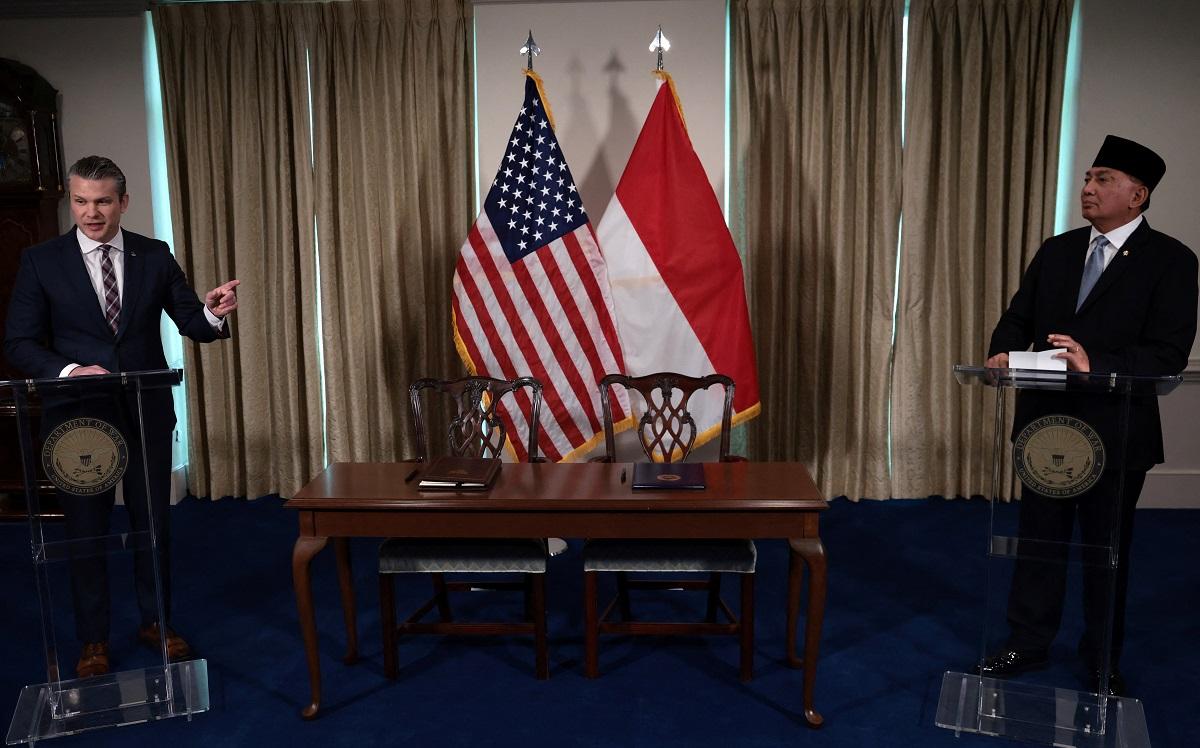
JAKARTA — Indonesia's foreign ministry warned the defense ministry in an early-April letter that an American proposal to give its military "blanket" permission to fly over Indonesian territory risked entangling Jakarta in potential South China Sea conflicts, sources said.
While the two nations agreed on a defense cooperation partnership in a meeting on Monday, a Pentagon statement that followed it made no reference to overflights, although two Indonesian sources said the US proposal had previously been slated to be signed there.
The foreign ministry's letter—which has not been previously reported—was marked as urgent and confidential. It was delivered ahead of the meeting between Defense Minister Sjafrie Sjamsoeddin and his US counterpart Pete Hegseth in Washington, the two Indonesian sources said.
In its letter the ministry urged the defense ministry to delay any final agreement with Washington. It is not clear if Hegseth and Sjafrie in fact discussed the overflight proposal.
In its statement the Pentagon said the two countries had established a major defense cooperation partnership and listed a number of ways in which they would build defense ties.
Indonesian defense ministry spokesperson Rico Ricardo Sirait told Reuters that overflight clearance was not "a pillar of cooperation agreed upon within the partnership."
A US official, speaking on condition of anonymity, said that just because the overflights were not mentioned in the statement did not mean they were not discussed in private.
The Pentagon did not immediately respond to a request for comment.
Sirait said the US proposal was being carefully reviewed by Jakarta, which had made a number of adjustments keeping in mind the country's sovereignty and national interests.
Indonesia, an archipelago of more than 17,000 islands, is located on the southern entry point of the South China Sea where it controls the Natuna Islands. The country is non-aligned and aims to keep close ties with both China and the United States.
China claims sovereignty over almost all the South China Sea, a waterway carrying more than $3 trillion in annual commerce, despite overlapping claims by the Philippines, Brunei, Malaysia and Vietnam.
Risks
The letter from the foreign ministry said the US proposal should be treated with caution because it would allow Washington to maximize surveillance and reconnaissance using Indonesian waters and territory, and could affect relations with other strategic partners in the region, including China.
It said an agreement with the US would give "the impression that Indonesia is involved in an alliance with the implication of increased national security risks because it places Indonesia as a potential target in a regional conflict situation."
It noted that a number of US military aircraft had carried out surveillance operations in the South China Sea on 18 occasions from January 2024 to April 2025, which constituted a violation of Indonesia’s territorial waters and airspace.
Indonesia’s protests regarding this operation have never received a proper response from the US, it added.
Indonesia's defense ministry "respects the views and input of all relevant ministries and agencies... Any proposal cannot be interpreted as final decisions," its spokesperson said responding to Reuters' questions on reservations raised by the foreign ministry.
Spokespersons for Indonesia's foreign ministry did not immediately respond to requests for comment.
Indonesia is a member of President Donald Trump's Board of Peace initiative, and has committed the largest contingent of troops for the body's proposed stabilization force in Gaza.
Indonesian President Prabowo Subianto has also maintained close ties with Beijing. His first foreign visit as president in 2024 was to Beijing and he attended a military parade hosted by President Xi Jinping late last year, being photographed with Russian President Vladimir Putin and North Korean leader Kim Jong Un.
The US and Australia joined the Philippines for their second joint maritime exercises in the South China Sea this year, amid tensions with China in the disputed waterway. — Reuters

