

 GMA Brandtalk
 Tracking
 Archives

EXPLAINER: Why Mindanao is sweltering as heavy rains drench Luzon, Visayas

Since the country entered the rainy season in June, parts of Luzon and the Visayas have been repeatedly drenched by heavy rains, disrupting daily activities, flooding communities, and prompting class suspensions.
Other parts of the country, however, are experiencing the opposite weather conditions.
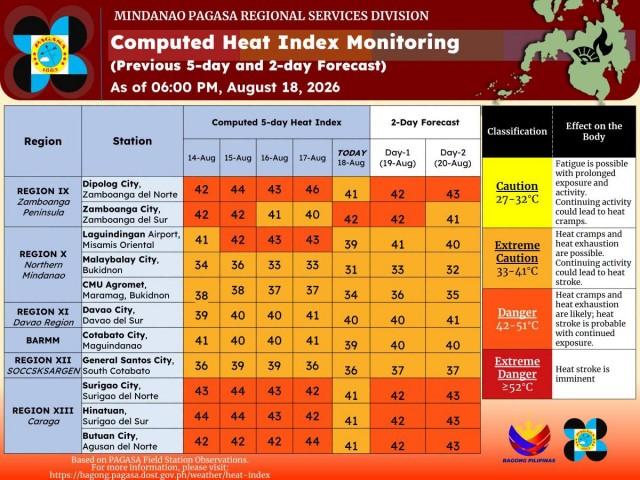
From last week through early this week, classes were suspended in parts of Mindanao—not because of flooding, but due to high heat indices that reached PAGASA’s “danger” category (42°C to 51°C), which can cause heat cramps, heat exhaustion, and heat stroke.
So why is Mindanao experiencing hot and dry conditions while parts of Luzon and the Visayas are being battered by heavy rains?
PAGASA weather specialist Chenel Dominguez told GMA News Online that the disparity is normal because of the Philippines’ size and varying climate patterns.
She said that the country has four climate types, and Mindanao does not have a distinct wet season.
“We have four climate types, and Mindanao does not have a distinct wet season. So when the rainy season begins in Luzon and the Visayas, it does not mean it is also the rainy season in Mindanao,” Dominguez said.
This explains why Mindanao can experience hotter conditions during the Habagat season, which typically affects the western sections of Luzon and the Visayas, she added.
“That is why they are experiencing hot weather right now—because they are not being affected by the Southwest Monsoon, or Habagat,” Dominguez said.
Dominguez also said El Niño has caused tropical cyclones to recurve away from the country instead of moving closer to land.
“Because of El Niño, tropical cyclones tend to recurve. They don't move close to our landmass, so the Habagat is more likely to be oriented toward Luzon and the western sections of the Visayas,” she said.
ITCZ
According to PAGASA, rainfall in Mindanao is usually influenced by the Intertropical Convergence Zone (ITCZ), which is currently not affecting the region.
“Usually, the ITCZ, or Intertropical Convergence Zone, is what brings rain to Mindanao. Currently, Mindanao is not being affected by the ITCZ, which is another reason why they are experiencing hot weather,” Dominguez said.
“Once the ITCZ develops and is oriented toward Mindanao, they may experience rainfall,” she said.
The ITCZ is a region where the trade winds from the Northern and Southern Hemispheres converge. According to PAGASA, it is among the weather systems that can trigger the formation of low pressure areas and tropical cyclones.
Dominguez also said there have been instances when the Habagat affected the entire Philippines, particularly when a tropical cyclone enhancing the monsoon was near the country's landmass.
“When that happens, Mindanao can also experience rainfall," she said.
In the coming days, PAGASA forecasts rainfall to be concentrated mainly over the Zamboanga Peninsula. —VBL, GMA News

