

 GMA Brandtalk
 Tracking
 Archives

Did you know? Ube is not just purple, and it's not exclusive to PH
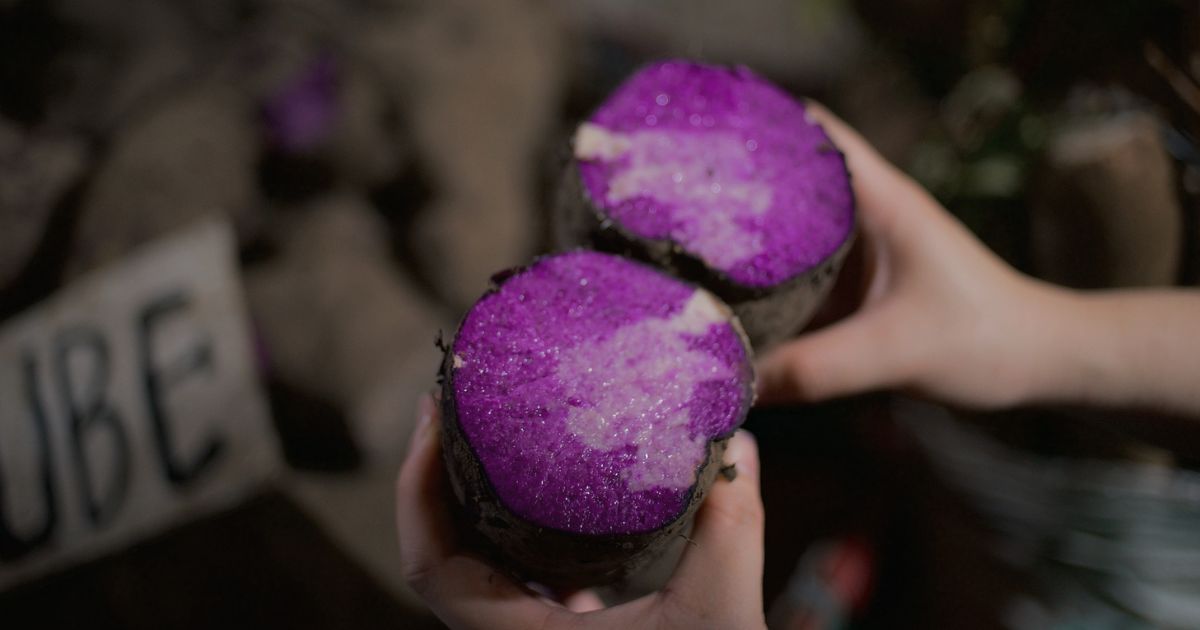
While ube is famously known for its deep purple hue, it is not limited to just one color.
In an interview with GMA News Online, Darel Kenth Solde Antesco, a licensed agriculturist and University Researcher I at the University of the Philippines Los Baños, explained that ube's flesh cortex color is influenced by several factors.
These factors include genetics, soil health, and nutrient composition. He further explained that ube gets its color from anthocyanin, a natural pigment also found in other fruits and vegetables.
Per the agriculturist, the intensity of ube's color depends on "the cultivar genetics, growing conditions, well-drained soil moisture, sufficient potassium availability, and levels of abiotic stress."
Cultivar means "cultivated variety," which is propagated for specific traits.
For example, in Batanes, there is a VU1 Basco cultivar with a white flesh cortex tinged with purple. In Leyte, a VU3 cultivar has creamy pink flesh, while in Negros, the Dayang 1 and Dayang 2 cultivars have white and yellow-orange flesh, among others.
For context, the "VU" designation refers to the institutional code of the developer, Visayas State University, formerly known as the Visayas State College of Agriculture.
Meanwhile, "Dayang 1," "Dayang 2," are considered traditional cultivated varietal names.
As a researcher who previously worked on the collection and conservation of root crops in the Philippines, including ube, Antesco believes the misconception that ube only comes in purple should be corrected to encourage wider appreciation and utilization of the crop, potentially leading to broader commercial use and continued cultivation in the future.
In addition, while the Philippines is strongly associated with ube on the global stage, the crop is not exclusive to the country.
Scientifically known as Dioscorea alata, Darel explained that ube has long been cultivated across exists in "parallel cultivation" across Southeast Asian countries and parts of Melanesia, reflecting the crop species' broader "center of origin" and "center of diversity."
However, he said that the Philippines is widely recognized as an important center of diversity for ube with wide locally adapted varieties and landraces that have become closely associated with Filipino cuisines and food traditions.
In the country, ube is widely cultivated in Bohol—known as the country's "Ube Capital"—as well as Benguet, Batangas, and Quezon, among others.
The Philippines have distinct cultivars, or plant varieties, like Ubi Kinampay of Bohol and Leyte Ubi, which it can proudly claim as uniquely Filipino.
"While ube itself as a crop need not be claimed in its entirety, the Philippines can rightfully promote its own unique and distinct cultivars like Ubi Kinampay of Bohol and Leyte Ubi, as superior and culturally significant products," Antesco said.
Read more on ube from our special report here. And in case you're craving for some ube treats, here are seven Metro Manila spots to visit. —MGP, GMA News

