

 GMA Brandtalk
 Tracking
 Archives

A doctor with 21,000 patients
Dr. Moses Princesa often gets a call in the wee hours of the morning to deliver a baby.
The 38-year-old is a general practitioner, not an obstetrician or a midwife, but he is the only public doctor the people of Busuanga town in Palawan—all 21,000 of them—can turn to.
His situation is far from the national average, which itself is a low 3.5 doctors per 10,000 people, based on the records of the Department of Health.
But it's actually better than the numbers for rural areas, where the doctor-to-population ratio is three doctors to 100,000 people.
In Busuanga, Princesa serves 24/7 as the lone municipal health officer, medico-legal officer and pediatrician.
If Princesa is done delivering the baby at 7 a.m., he is expected to arrive on time for his regular 8 a.m. to 5 p.m. duty at the municipal health office. But his work does not end at 5 p.m., as people still seek him for consultation outside office hours, even going to his house for emergencies.
He admitted that he barely has time for his wife, who is six months pregnant with their second child, and their three-year-old son, Isaac.
But this is just part of his sacrifice as the health officer for the whole of the third-class municipality.
Serving his country
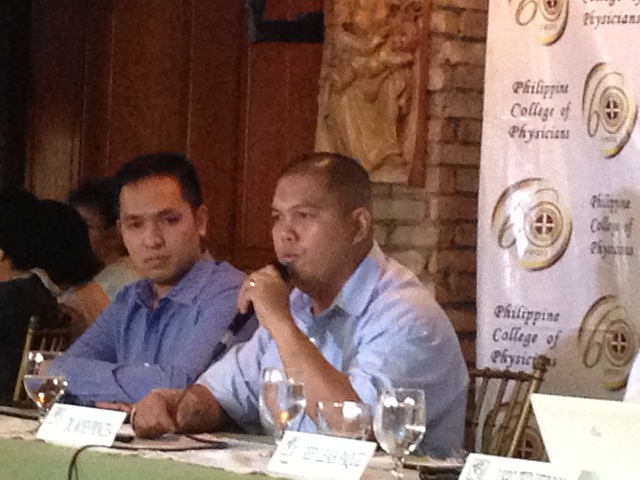
Princesa said he is sustained by his faith.
"God's grace. That's the only thing that is sustaining me," Princesa told reporters in a health forum in Quezon City Tuesday. "It is my faith because kung wala yan, kung trabaho lang ang hinahabol ko hindi na ako nagpursige sa malayo."
Princesa cried as he recalled the plight of his poor patients and his inability to save some of them.
“Titignan ka nila, sasabihin nila wala kaming pera, Doc. Makikita mo yung tao mamamatay. Ayokong masanay na ganun, buhay pa rin 'yun,” he said.
He lamented that Busuanga does not have an ambulance to bring the patients to the nearest hospital 55 kilometers away.
“Yung ambulance namin hindi tumatakbo, wala naman kami kahit mahiraman,” said Princesa.
A shortfall of 30,000
At the same forum, Health Undersecretary Ted Herbosa said the Philippines has a shortage not only of doctors but of healthcare workers in general, including nurses and midwives. This is not a new situation; the exodus of Filipino medical professionals from the country started as early as the 1960s, he said.
He thanked Princesa, who was his student, for deciding to stay in the country and serve his countrymen.
Herbosa added that the ideal ratio should be 1 doctor per 1,000 population. To achieve this ratio, he said, the country needs 30,000 more doctors.
He said the Professional Regulation Commission issues licenses to 72,000 doctors a year but that many of these new health professionals choose to go abroad. He further said that many of those who stay in the country are in the urban areas “where people have a living.”
Herbosa admitted that the government cannot address the problem alone, and called on the help of the private sector and the academe.
Access inequity
Among the steps taken by the government to address the needs of rural Filipinos are the DOH's Doctors to Barrios program as well as scholarships given to medical students with the proviso that they serve in public hospitals after graduation.
However, “We do not give value to our health workers,” said NARS party-list Rep. Leah Paquiz at the same forum.
She said many health workers are employed as contractuals and are dismissed arbitrarily.
“They became vulnerable to exploitation and became pawns in the world of precarious working conditions. Hapless health workers take on false volunteer programs in dire exchange for training or employment certificates which is not given to them. Some even pay the hospitals for these training,” she said.
She added that some health workers volunteer and take on the work of a regular employee without pay just so they can practice in a hospital and are not protected from the risks and hazards in the performance of their duties.
"The crisis of the Philippine healthcare workforce is not only that of a shortage of workers, but also of serious inequity in the ability of the rich and poor to access doctors," she further said.
"There is a huge discrepancy in the quantity and quality of health care services received by the poor and the rich, which at its extreme, are world class for millionaires, while insufficient for the poor and marginalized groups," said Paquiz.
Dr. Antonio Dans, president of Philippine Society of General Internal Medicine (PSGIM), said the chronic deficit and inequity of health professionals is a complex, systemic problem and should be considered as a crisis.
Among the factors contributing to this crisis are:
- the cross-country migration of Philippine health workers to more developed areas such as the United States, Europe, and the Middle East;
- the intensity of urbanization and rural-to-urban migration, which has led to a disproportionate concentration of health professionals in urban centers such as Metro Manila;
- the lack of incentives that encourage doctors to over-specialize, and to seek employment in the private sector while the public health sector remains understaffed; and
- the lack of priority of health and the state of the healthcare workforce in public policy, which has remained despite the devolution of heathcare to local government units. — BM, GMA News

