

 GMA Brandtalk
 Tracking
 Archives

57% of adult Pinoys open to working abroad for economic reasons - OCTA Research

Majority of adult Filipinos are willing to work abroad if given the opportunity, citing better job opportunities, higher wages, and better quality of life, OCTA Research said on Monday.
This was according to OCTA Research’s Tugon ng Masa (TNM) poll conducted from March 9 to 25, 2026 through face-to-face interviews with 1,200 respondents aged 18 and above. The survey has a ±3% margin of error at a 95% confidence level.
“Migration is not a fringe aspiration – it cuts across regions, income groups, and educational levels,” it said.
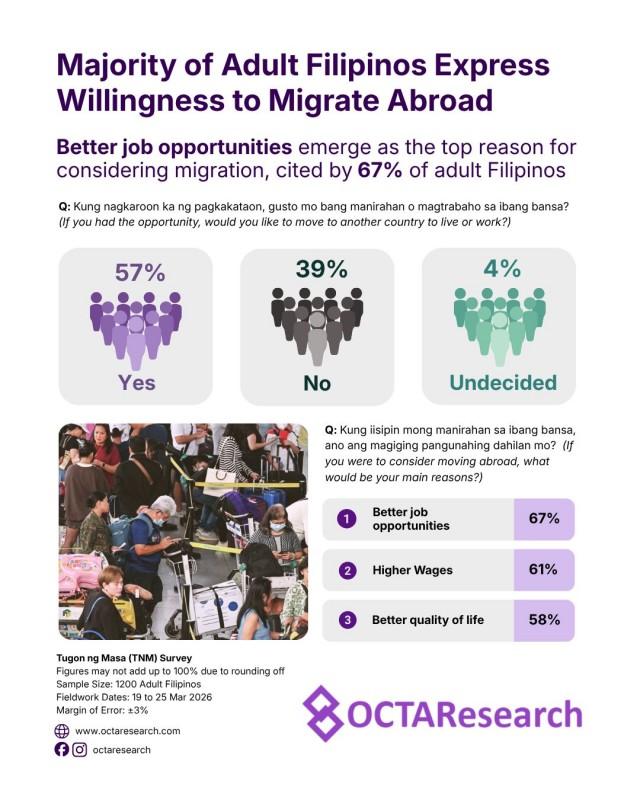
According to the poll results, 57% of adult Filipinos said they would be willing to live or work abroad if given the opportunity, while 39% said they were not willing to migrate, while 4% were undecided.
Across major areas, willingness to migrate was highest in Balance Luzon at 59%, followed by Mindanao at 56%, Visayas at 55%, and NCR at 53%.
Meanwhile, unwillingness to migrate was highest in the National Capital Region at 45% and lowest in the Visayas at 34%. The Visayas also recorded the highest share of undecided respondents at 11%.
In terms of socioeconomic class, willingness to migrate was nearly uniform, with 57% among Classes D and E and 56% among Class ABC.
Unwillingness was slightly higher among Class E at 40%, followed by Class D at 39% and Class ABC at 38%. On the other hand, indecision was highest among Class ABC at 6%.
OCTA Research said these findings suggest that “migration remains a mainstream aspiration among Filipinos rather than a preference limited to specific sectors of society, and continues to occupy an important place in how many Filipinos envision economic advancement, career development, and long-term family well-being.”
The poll also found that the top reasons for considering migration were mainly economic.
Respondents cited better job opportunities at 67%, higher wages at 61%, and better quality of life at 58%.
Other reasons for migration were education opportunities at 20%, gaining international experience at 20%, family reunification at 16%, and safety or political stability at 14%.
By socioeconomic class, Class E respondents were most likely to cite better job opportunities at 72% and higher wages at 74%.
In comparison, Class ABC respondents placed relatively less emphasis on wages at 46%, but showed higher interest in education opportunities at 32% and gaining international experience at 26%.
OCTA Research also noted that although safety or political stability ranked last among the reasons cited at 14% nationally, its distribution across subgroups reveals a distinct pattern.
It was cited most prominently in Region I (Ilocos Region) at 34% and Region III (Central Luzon) at 21%, which suggested that in specific Luzon provinces, political and security considerations carry more weight in the migration calculus than the overall average implies.
By socioeconomic class, it was more commonly cited among Class D (15%) and Class E (16%) than Class ABC (7%), which suggested that security as a migration factor weighs more heavily on lower-income households than on the educated middle class.
“Overall, the survey results suggest that migration remains an option many adult Filipinos are willing to consider, particularly younger respondents, urban residents, and those with higher educational attainment. The reasons cited are largely economic, with better job opportunities, higher wages, and improved quality of life emerging as the leading motivations,” the poll firm said.
It added that “the variation across regions, age groups, and educational levels indicates that attitudes toward migration are not uniform and may reflect different personal circumstances, economic expectations, and life-stage considerations among respondents.”
“Better jobs, higher wages, and improved quality of life consistently emerge as the dominant motivations across most demographic groups. This pattern indicates that migration is largely viewed as a pathway toward advancement and upward mobility rather than simply a response to hardship or instability,” OCTA Research said, adding that migration should be understood “not merely as a demographic phenomenon, but as a reflection of broader development challenges and opportunities facing the country.”
It also noted that the survey measured openness to migration and not concrete plans to leave, stressing that the results “should not be interpreted as a direct measure of dissatisfaction with conditions in the Philippines.”
“Rather, they provide insight into how Filipinos assess available opportunities and the extent to which international mobility remains an attractive option for improving their economic prospects and quality of life,” it said.
OCTA Research underscored that the challenge for policymakers is “how to make comparable opportunities increasingly available at home,” given that migration aspirations of Filipinos are a labor market problem.
“Filipinos want better jobs, higher pay, and more promising futures – and as long as those are more reliably found abroad than at home, migration will remain a rational choice. The policy response must therefore go beyond investment pipelines and economic growth targets. It must grapple directly with the quality of work available to ordinary Filipinos,” it added. — JMA, GMA News

