

 GMA Brandtalk
 Tracking
 Archives

ADVERTISEMENT
Filtered By: Sports
Sports
SPECIAL REPORT: SEA Games results hint at alarming decline of PHL sports
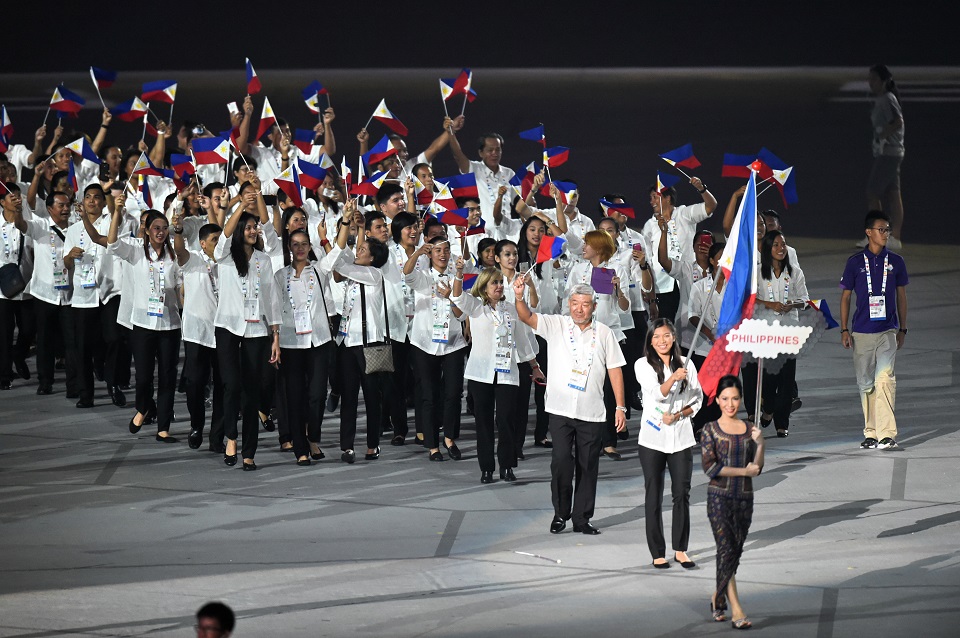
Team Philippines at the 2015 Southeast Asian Games. AFP PHOTO / ROSLAN RAHMAN
This is the first of a three-part special report on the declining state of Philippine sports.
Two years ago, the Philippines recorded its worst ever finish in the Southeast Asian Games, ranking seventh in the medal table after winning just 29 golds with the token delegation of 148 athletes sent in Myanmar.
In Singapore this year, despite sending a delegation of 466 athletes, the Philippines did not manage to improve on its gold medal tally, even as the country moved to sixth place in the standings.
Still, Philippine Sports Commission chairman Richie Garcia defended the output as a "fair performance."
"I'm not saying it was very good, I'm not saying it was also a debacle like what other people would say," he told GMA News Online in an interview.
But while Garcia is happy with the country's overall ranking, a look back at the numbers exposes just how disappointing the results were in the context of the Philippines' 38-year participation in the biennial games.
Until 2005, when the Philippines won the overall championship in Manila, the country had never failed to land outside the top five in the medal tally, even ranking at least third in nine of 15 appearances until then.
But after the euphoria of that championship 10 years ago, the Philippines suddenly plunged into lackluster performances in succeeding Games. The country dropped to sixth in 2007, climbed back to fifth in 2009, and then sank again in the next three editions with no sign of returning to its former glory.
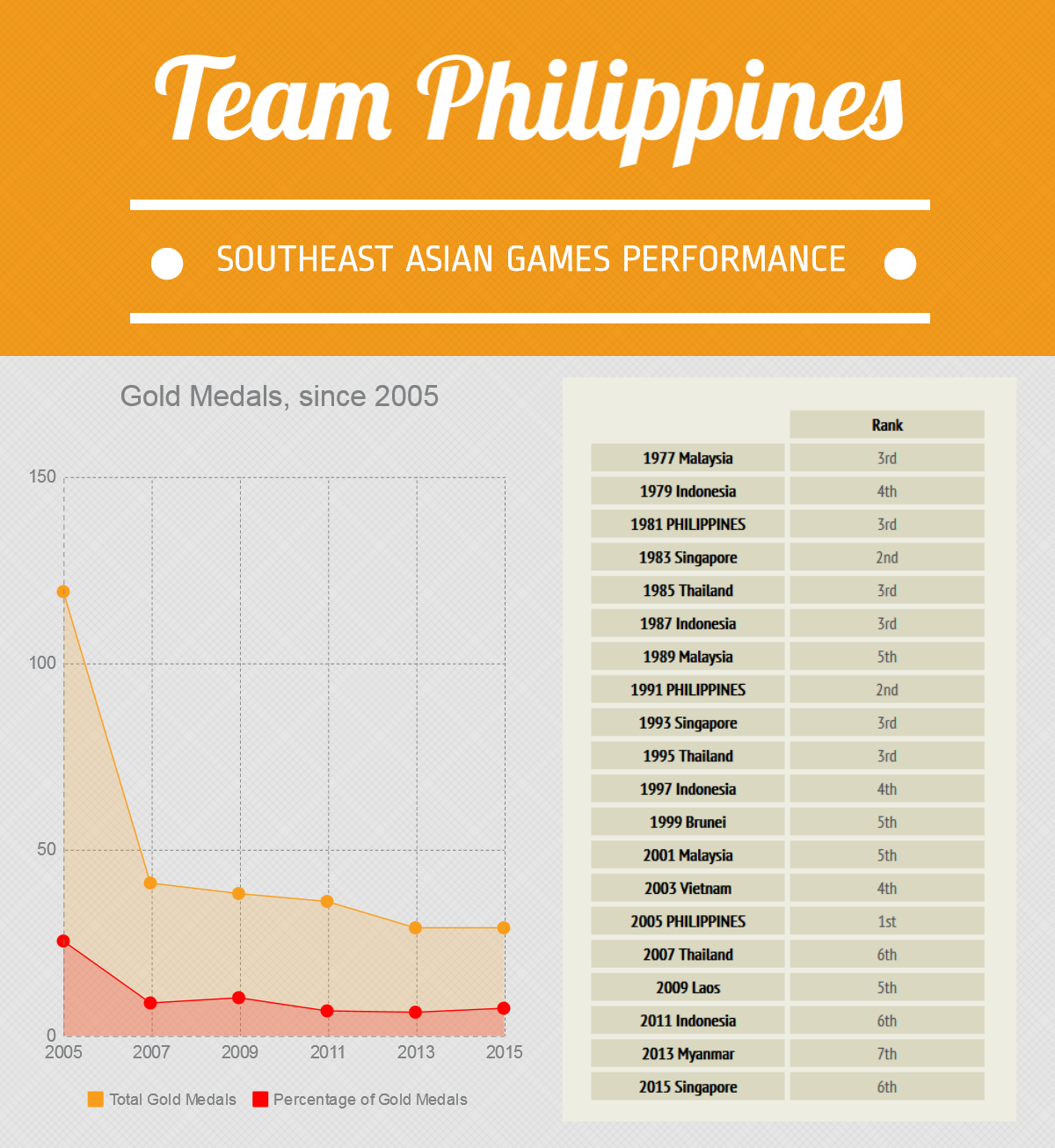
In 20 appearances since its debut in 1977, the Philippines has an average of 13.38 percent of the total gold medals in contention and 14.97 percent of the total medal tally. The country registered its best performances in 1981, 1991, and 2005, the years it hosted the Games, grabbing an average of 25.21 percent of the gold medals contested in those three editions.
The host country enjoys a massive homecourt advantage against other participating nations owing to its control over which sports disciplines and events would be held, resulting in outlier performances such as the Philippines' victorious 2005 campaign.
Discounting the Philippines' hosting stints, the country averages 11.29 percent in gold and 13.63 percent in overall medals. The 29-gold output in Myanmar and Singapore for the past two editions of SEAG, however, just account for 6.29 percent and 7.2 percent, respectively. Even the 36 golds in the 2011 Games in Indonesia is only 6.5 percent of the gold tally, way below the Philippines' average haul.
Garcia, however, blames the strategy of host countries of manipulating events as one of the reasons why the Philippines did poorly in the medal tally of recent Games, noting how both Myanmar and Singapore increased the medals contested in their strong disciplines and did away with other events.
"How will you project the number of gold if hindi ko nga alam kung anong dagdag, anong bawas 'di ba?" he said.
The PSC chief also said that host countries have ways of helping their athletes win several medals, citing the nine-gold haul of Singaporean swimmer Joseph Isaac Schooling in the 2015 SEAG.
"You can never win nine gold medals," he said. "Because kung regular lang 'yung event, there will always be a conflict between one event and another. They made the schedule in such a way na 'yung swimmer nila hindi mapagod.
"Those are the things that is part of SEA Games now," Garcia added. "It's hard."
The Philippines gets a fair share of its medals in four discplines: athletics, billiards, boxing, and taekwondo, all of which constantly deliver medals for the country every edition of the SEA Games. Even as other sports have declined in performance over the last five Games, the four sports somehow managed to continue their steady contribution.
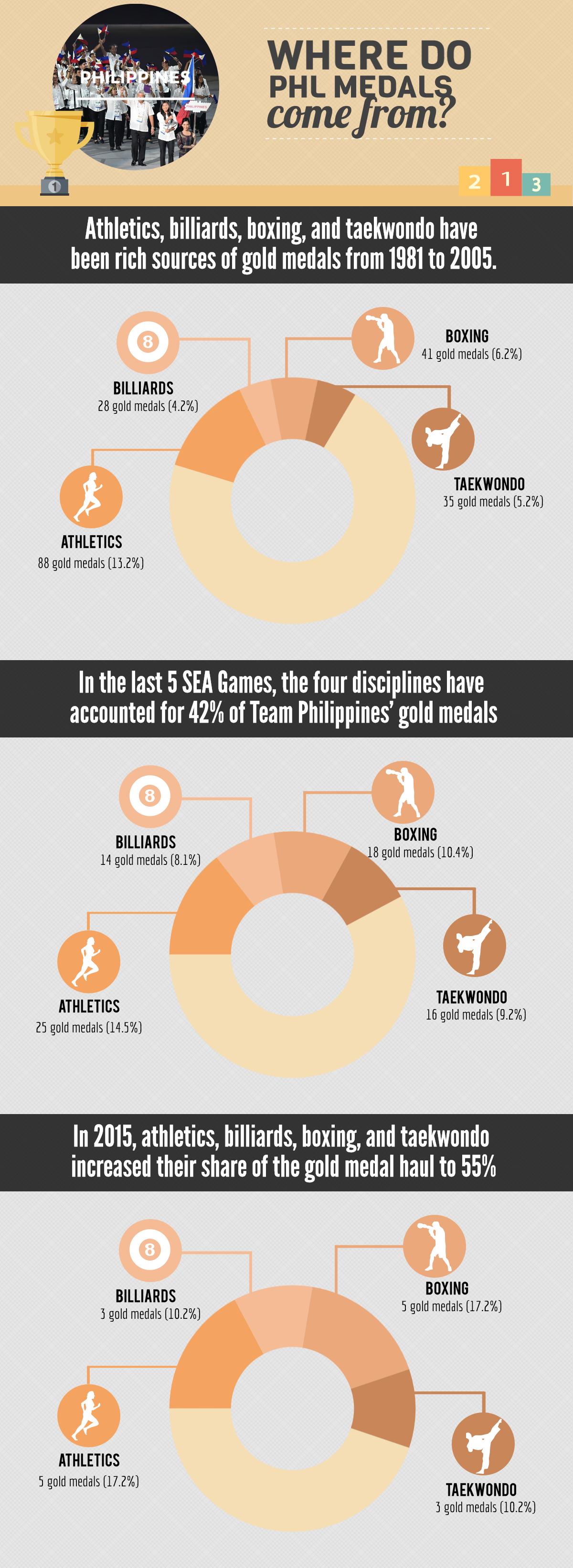
Since 1981, athletics has accounted for an average of 6.28 golds and 19.11 medals overall, accounting for 13.47 percent and 11.29 percent of the Philippines' respective gold and medal haul on the average SEAG year. It tallied its best output in 1983 when it bagged 11 gold, 11 silver, and 10 bronze for a total of 29 medals.
As one of the medal-rich disciplines in the SEA Games, athletics has done its part and never failed to produce a gold medal for the Philippines since the country hosted the 1981 Games. In its worst finish in 1999, it still gave the country 11 medals with one gold to go with five silvers and six bronzes.
Billiards, meanwhile, cops an average of three golds and 7.64 medals overall, with a best performance of eight golds and 11 total medals in 2005. Like athletics, it has always delivered a gold medal for the Philippines even in its worst year - coming up with one gold of its four medals in 1993.
Boxing also remains one of the country's strongest sports in the Games with an average of 3.2 golds and 8.2 medals every edition. It recorded its best output in 1991 when the Philippines hosted the SEAG, notching eight golds of its 10 medals total.
The only time it went home empty-handed in the gold medal category was in 2001 when it won just five silvers and two bronzes, while its poorest showing in the medal table came in 1999 when it bagged only one gold and one bronze.
The Philippines also enjoys a good performance in taekwondo, which averages 3.4 golds and 11.47 total medals. It registered a best output of eight golds and 15 medals in 1991 after its meager three-silver, five-bronze finish in 1989.
Until 2005, these four disciplines alone already accounted for an average of 26.21 percent or more than a fourth of the Philippines' total medal tally. But when the country's decline began in 2007, the chips in the medal table provided by these four rose to 30.41 percent.
More alarmingly, they account for an average of 42.19 percent in gold medals over the last five SEA Games - an increase of more than 10 percent from the 31.86 percent they provided in the past years.
Without a significant increase in production from the four sports except boxing, this means that the Philippines is becoming heavily dependent on just four events as its lifeline with its dwindling performance in the medal tally.
The country's slump in the SEA Games medal table can be attributed to various levels of decline in several different sports. Erstwhile steady contributors such as bowling, shooting, and weightlifting suffered a drop in their performances before the turn of the millennium.
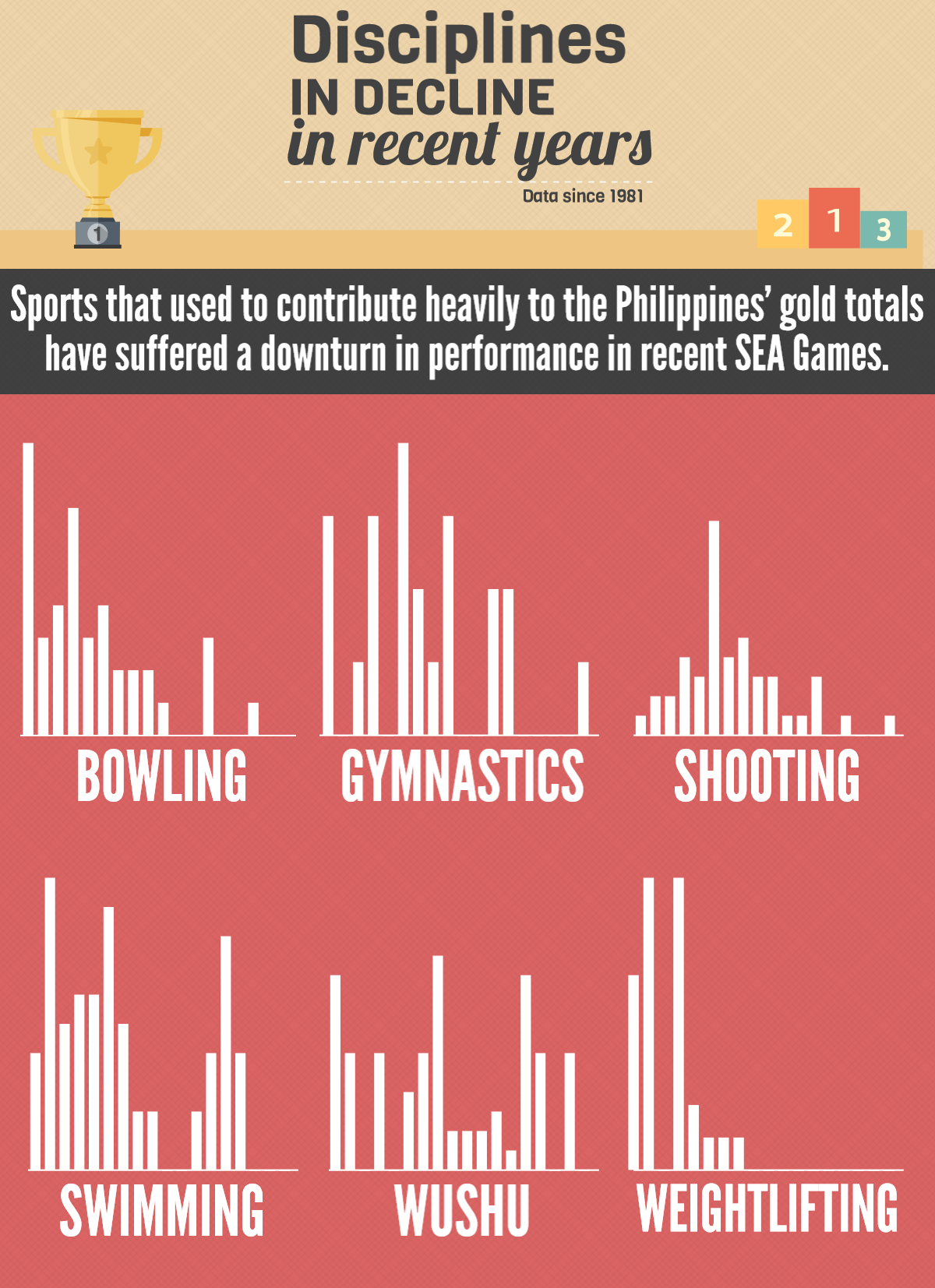
From 1981 to 1997, bowling averages an output of 11 medals including four golds. This was the Bong Coo-Paeng Nepomuceno era, when the two legends led the Philippine team in the SEAG alley. After they retired from competing in the Games, medals from the discipline became scarce for the Philippines.
In the last six editions where bowling was held, the sport produced only five golds from its 26 total medals, or an average of just 4.33 medals per SEAG. The two bronze medals it won this year in Singapore was among its worst finishes along with the sole silver medal in 2007.
Shooting, for its part, is also one of the heavy medal contributors to the country with an average of 21.22 medals and 3.89 golds from 1981 to 1997. It registered its best finish in 1991 with 11 golds of 28 medals.
The discipline came up with likewise strong outings in the next three editions, but suddenly sank in performance the following Games. It averaged just 4.33 medals, a little more than a fifth of its average the years prior, and even went home empty-handed in 2011 and 2013.
Not even the home court advantage in 2005 was able to bring back its top form, bagging only three golds of its nine medals total. In Singapore this year, it only had five medals to show with a pair of gold and silver to go with three bronzes.
The Philippines also depended on weightlifting for medals in its early years in the Games. The sport averaged 11.25 medals including 3.63 golds from 1981 to 1995, the year it last won a gold medal for the country.
In the last 20 years, however, it only averaged three medals every SEAG and had zero golds to show in any edition.
Gymnastics and wushu, meanwhile, visibly had lower outputs after the Philippines' hosting in 2005. From 1981, gymnastics delivered an average of 9.27 medals every edition and only twice failed to deliver a gold medal - in the 1989 and 2001 Malaysia Games.
But after country hosted the SEAG in 2005, the discipline was blanked in the next three Games it was held. It only just recovered slightly this year, with one gold, one silver, and two bronze medals to show.
Wushu is also one of the country's medal mines since it was introduced in 1991, averaging 14.33 medals including 7.17 golds until 2005.
After its glorious 11-gold, 19-medal finish in Manila, however, its output almost halved with an average of only 7.6 medals to show in the last five SEAG and only two golds per edition.
A more recent underperformer is swimming, which used to be one of the heavy medal contributors for the Philippines. From 1981 to 1997, Filipino tankers delivered an average of 15.22 medals including 5.44 golds per SEAG.
That was the reign of legendary swimmers William Wilson, Eric Buhain, Akiko Thomson, and Ryan Papa, who share 38 golds between them during the zenith of Philippine swimming.
After their retirement, however, the country plunged to sudden free fall and failed to deliver a gold medal in the next two Games, copping only 11 silvers and six bronzes or an average of 8.5 medals.
Swimming enjoyed a resurgence in the 2000s with the emergence of two-time Olympian Miguel Molina. He won a total of 11 gold medals in the SEAG from 2003 to 2009, and was named as the SEA Games Most Outstanding Athlete in 2007.
During his era, the Philippines' medal average in the SEAG pool hiked back to 13.2 per edition including 4.5 golds. But with his retirement, swimming once again sank in the medal tally. The country never won a gold in the discipline in the last three Games despite producing two Olympians, Jasmine Alkhaldi and Jessie Lacuna.
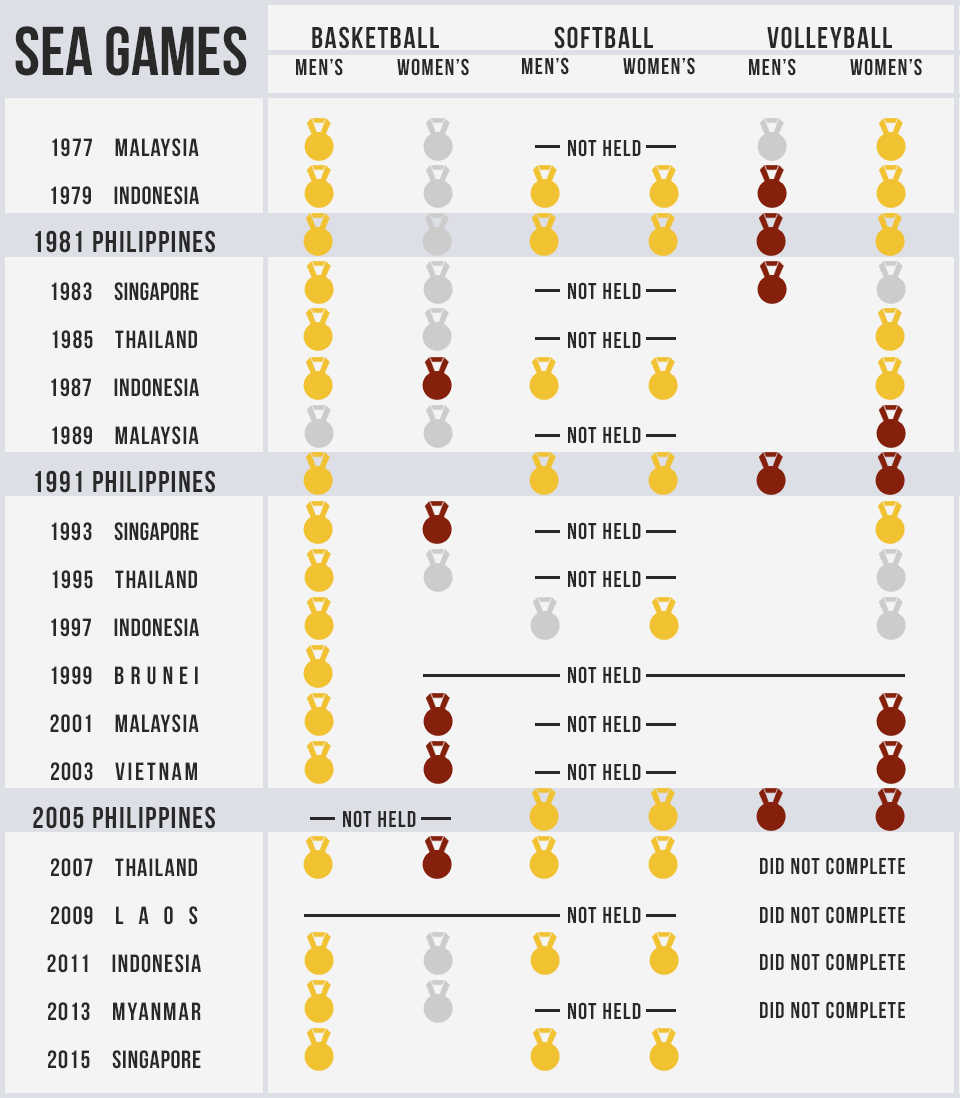
Men's basketball is the most heralded team event for the Philippines in the SEA Games. The national squad has been lording over the SEAG hardcourt since the country began participating in 1977, winning all gold medals but one when the 1989 team settled for silver in the upset loss to host Malaysia.
Their women's counterpart, meanwhile, has yet to win a gold medal in the Games but consistently make it to the podium with nine silvers and five bronzes in the 17 editions the event was held. The team missed the top three only thrice - in 1991, 1997, and this year.
Women's volleyball was dominant from 1977 to 1997, winning six golds, three silvers, and two bronzes in the 11 editions held in that period. The sport was not held in Brunei the following Games in 1999, and the Philippines settled for the bronze in the next three editions at the turn of the millennium.
After the country's hosting in 2005, the Philippines did not participate in the discipline in the next four SEAG. The country only sent a squad this year, but the team led by superstar Alyssa Valdez and team captain Jovelyn Gonzaga became the first ever squad from the the Philippines to fail to make it to the podium in the Games.
The men's team has been struggling more than the women's, but they likewise had a better showing in the early editions. It has yet to duplicate its best finish in its 1977 debut when it bagged the silver medal, but it has won the bronze in the next three SEAG and bagged two more in 1991 and 2005 when the country hosted the Games.
Unknown to many, though, the most successful national team sent by Philippines to the SEA Games is women's softball, which has won all the gold medals in the nine times the sport was held since 1977. Their men's counterpart has been just as strong, winning all golds but one when it fell short and bagged silver in 1997.
Another alarming trend in the SEA Games history of the Philippines has been the lack of gold medals in four mainstream sports: football, badminton, table tennis, and sepak takraw.
The country has never won a medal in men's football and only has a lone bronze from the women's team. Badminton likewise has zero gold and silver, with only six bronzes to show since the Philippines began competing in 1977.
Table tennis has seven bronzes and two silvers, the second of which was won by Richard Gonzales this year in Singapore to duplicate his feat in the 2005 Games.
The Philippines has done poorly in sepak takraw, a non-Olympic sport but a popular event in Southeast Asia and a regular discipline in the SEAG. The country only had two silvers and 12 bronzes since 1977. —JST, GMA News

