

 GMA Brandtalk
 Tracking
 Archives

ADVERTISEMENT
Filtered By: Sports
Sports
SPECIAL REPORT: Two divers, one diving board, and a pool of embarrassment for Team Philippines
This is the second of a three-part special report on the sorry state of Philippine sports. Click here to read part one, which discussed the alarming trends for Team Philippines at the Southeast Asian Games.
Last month, two Filipino divers made waves in the Southeast Asian Games for the wrong reasons: their failed dives in the men's 3m springboard.
John David Pahoyo and John Elmerson Fabriga received zero points for each of their dives and finished dead last in the competition. They also finished in last place in the men's 3m synchronized springboard.
Ultimate Diving skills spotted at SEA GAMES 2015 Courtesy of the Filipino Diving Dynamic Duo :P#ZeroFighters #MustWatch
Posted by All Singapore Stuff on Wednesday, June 10, 2015
The dives went viral on social media, and the pair was ridiculed worldwide for their poor performance. Many Filipino fans rallied behind the pair after Pahoyo noted how well they fared in the synchronized dive despite having just four days of practice before the competition.
But it also begged the question from concerned netizens: Why only start practicing their synchronized dives days before the SEA Games started?
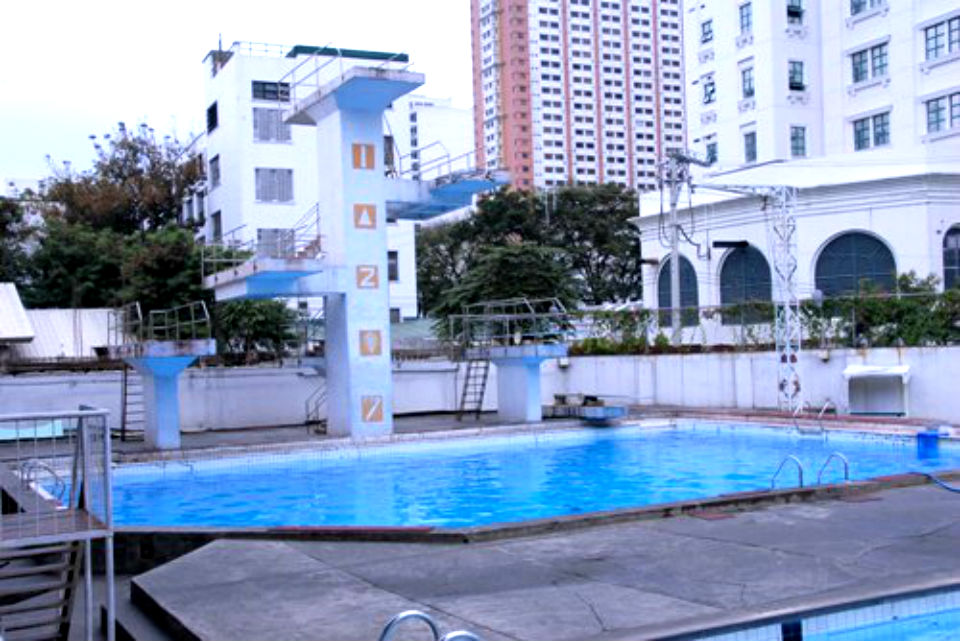
"Four days lang po kami nakapag-ensayo nung actual na synchro dive sa pool, kasi po isang set lang po ng 3m springboard ang meron dun sa Rizal Memorial Sports Complex," Pahoyo told GMA News Online in an interview.
The 18-year-old diver said he and his partner Fabriga have been training together since January, but they were already preparing for the SEA Games tilt as early as June last year.
With only one springboard in RMSC, however, they were only able to practice their synchronized dives in an actual diving pool when they arrived in Singapore. They had to make do with practicing away from the water while they were here in the Philippines.
"Meron po kaming two sets ng springboard sa dry gym," said Pahoyo. "Foam lang po 'yung nilalandingan namin."
Pahoyo said the RMSC pool is already the best operational diving pool in the country available to them in the country, and their inability to train in a much better facility was a huge factor in their performance in Singapore.
Indeed, in a conversation that was caught by the official coverage of the Games, Pahoyo and Fabriga could be heard telling each other that they were nervous after their failed dives.

But it's certainly not true that the RMSC is already the best place in the country for training for diving competitions. The Philippines actually has a facility which satisfies the requirements of international aquatics competitions: the Trace Aquatic Center in Los Baños, Laguna, which hosted the aquatics events in the 2005 SEA Games.
"It's a beautiful facility" is how Mark Joseph, the head of the country's national sports association for swimming and diving, describes Trace.
Under Joseph, the Philippine Amateur Swimming Association (PASA) selected Trace in 2006 to be the Philippine Center of Excellence for Aquatic Sports, which was inspired by the Singapore Sports School and the Australian Institute of Sports.
The law mandates that government support for national sports associations (NSAs), including funds from the Philippine Amusement and Gaming Corporation (PAGCOR), be coursed through the Philippine Sports Commission.
But in August 2007, then-PSC chairman William Ramirez authorized PAGCOR to release funds to PASA. This amounted to some P37 million, which the association used to pay for the rental and maintenance fees for the use of the aquatic center between September 2007 and December 2008.
The catch: Trace is owned by the family of Efraim Genuino, who was then the chairman of PAGCOR. Today, the Trace College website still lists Genuino as the chairman and CEO of the Trace Group of companies.
In 2011, two cases were filed before the Ombudsman by PAGCOR and a group of athletes, coaches, and sports enthusiasts led by former senator Nikki Coseteng against Genuino, Ramirez, Joseph, and other PAGCOR officials. Last January, in an 18-page joint order, the Ombudsman indicted Genuino, Ramirez, Joseph, and five others for violation of RA 3019 or the Anti-Graft and Corrupt Practices Act.
"Without any doubt, the grant of direct financial assistance authorized by respondent Genuino in an entity which he himself effectively owns and controls smacks of self-dealing," the Ombudsman said.
The swimming association, since renamed Philippine Swimming, Inc. (PSI), has stopped using Trace for the training of the swimmers and divers. Joseph denies, however, that it had something to do with the pending case.
"When the government changed, we did not have the support to keep our athletes in there," he said. "We couldn't afford to maintain it."
But in interviews after the SEA Games debacle involving the divers, current PSC chairman Richie Garcia denied that there were no funds available to the country's swimmers and divers. He said that the PSC allocated P24 million for the country's swimming association, but the PSI only availed P4 million from this budget.
The reason, according to Garcia: the swimming association could not present a viable program.
The reason, according to Garcia: the swimming association could not present a viable program.

Another problem hounding Philippine sports, according to Philippine Sports Commission chairman Riche Garcia, is the absence of continuity in the athletic program due to the lack of a fixed tenure for the government's top sports official.
In its 21 years of existence, the PSC already had nine chairmen who held office: Cecilio Hechanova, Aparicio Mequi, Gemiliano Lopez Jr., Philip Ella Juico, Carlos Tuason, Eric Buhain, Harry Angping, and Garcia himself.
Among all of them, Garcia is the first to reach five years in the position. Prior to him, Buhain and Ramirez had the longest term of four years as they served from 2001 to 2005 and 2005 to 2009, respectively.
"If you keep on changing chairman, 'yung mga policy, 'yung mga program, they keep on changing," Garcia said. "That's the weakness na walang term."
This frequent changing of administrations directly affects athletes, as it disturbs their training programs for international competitions.
In a 2013 interview, four-time Southeast Asian Games gold medalist and Olympian long jumper Marestella Torres said her training in Germany for the 2010 Asian Games was affected due to Angping's departure from the post.
"Plano sana ng coach ko nun, from Germany diretso na kami ng China para sa competition ng Asian games," she said. "Dapat six months 'yun e. Tapos, medyo nagkaproblema nung umalis siya.
"Ang nangyari, wala, nasira 'yung plano namin dahil dun sa mga budget-budget," she said. "Napauwi ako ng maaga dito, one month before ng competition. So parang nag-back to zero ako."
Torres, who was fresh off winning the gold medal in the 2009 Athletic Asian Championships, did not even make it to the podium in the Asiad. She could have landed a silver with that performance, not to mention a real shot at the gold with the 6.68 meter record-breaking leap she made in the 2009 SEA Games.
Garcia said that converting PSC into a Department of Sports could solve the problem of discontinuity, as a cabinet secretary has a term of six years.
"Even in five years time, you can never really produce a super athlete," he said. "If the next chairman will continue [the programs], then you will see the fruits later on."
In addition, Garcia said that creating a Department of Sports will put the sector closer to President and could air their grievances in cabinet meetings. It will also help in grassroots training, as departments have the capacity to establish regional offices. —Marisse Panaligan/JST, GMA News
What could not be denied, however, is that the decrepit state of the country's sports facilities is one of the main reasons why the country is lagging behind in international competitions such as the SEA Games.
Even Garcia, who took over the PSC chairmanship in 2010, admits so.
Our neighbors in Southeast Asia, he said, all have training centers providing ideal conditions for athletes, such as a pollution-free environment and a central cafeteria that provides and strictly monitors their nutritional needs.
"If you look at the sports na maganda ang performance, saan sila? Dun sa Baguio," he told GMA News Online. "But we cannot make everyone train in Baguio. If you send other sports, hindi na puwede dun, masikip na."
Athletics and boxing are two disciplines that usually hold training camps in the high-altitude northern city, and both of them are consistent medal contributors for the country in the SEA Games. In Singapore this year, they accounted for five gold medals each - the most for any discipline where Filipinos competed.
But the other sports have had to settle for training at the Rizal Memorial Sports Complex in Manila, which was built for the 1934 Far Eastern Games, and the Philsports Complex in Pasig City, which was built in 1975.
These facilities hardly provide ideal conditions, according to Garcia.
"Wala na 'tong Rizal Memorial for sports. Kung pipilitin natin diyan, walang mangyayari," he said. PhilSports Complex is a lot worse, the PSC added, because of the air pollution owing to its proximity to factories in neighboring city Marikina.
A new training center will solve a lot of problems hounding Philippine sports, which is why Garcia is the government to fund the construction of a new sports complex in Clark in Pampanga.
"That's the number one that we should be thinking about. I think it will go a long way to have facilities like that," he said.
The PSC and the Clark International Airport Corporation, which currently controls the site eyed as location for the sports facility, are already working on a memorandum of agreement regarding the use of the land. The issue of funding, however, has yet to be resolved by Congress, which has the power to authorize the release of a budget for the project.
In earlier interviews, Garcia pegged the cost of the new sports complex at P3.5 billion.
"Pera lang ang hinihintay. The land is there. If the government will fund it, we can finish that in maybe a year," Garcia said.
But according to Pampanga representative Joseller "Yeng" Guiao, the vice-chairman of the House Committee on Youth and Sports, that may be an optimistic projection from Garcia.
"Ang crucial diyan, it's not really the PSC or the Philippine Olympic Committee na may last say diyan eh. Ang may last say diyan 'yung presidente," he said.
Guiao thinks the decision will probably rest on the next president who will be elected in 2016. He estimates that construction could go beyond 2019, when local sports officials hope to host that year's edition of the SEA Games.
Until then, athletes like Pahoyo will have to endure training in our sorry sports facilities.
"Sa ngayon po is hindi po talaga uubra 'yung mga facilities natin compared sa ibang bansa," said Pahoyo. "And it really affects the performance of the athletes."
Until then, too, Filipino sports fans should not be surprised if there are a few more embarrassing performances from our athletes in international competitions. —JST, GMA News

