

 GMA Brandtalk
 Tracking
 Archives

Mali's preserved remains go on display at National Museum
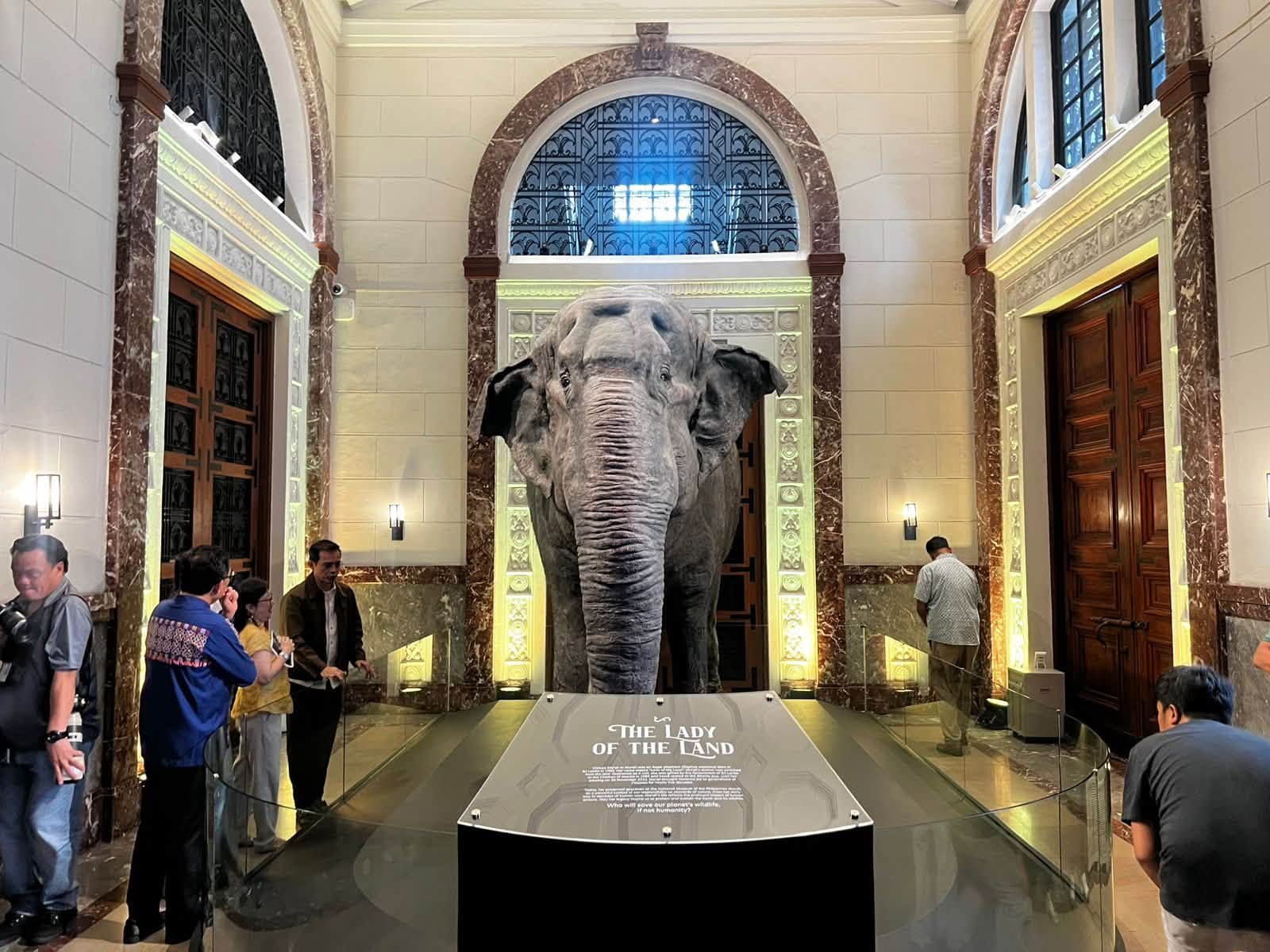
For nearly five decades, Mali the elephant lived in the public eye.
Brought to the Philippines from Sri Lanka in 1977 at the age of three, Vishwa Ma’ali, known as Mali, spent almost her entire life at the Manila Zoo, where she became one of its main attractions and the country’s only elephant.
Now, nearly three years after her death, Mali remains on display—this time as a taxidermied specimen at the National Museum of Natural History, which also houses the preserved remains of Lolong, recognized by Guinness World Records as the largest saltwater crocodile in captivity.
The Manila local government and the National Museum announced the transfer of her preserved remains on Thursday, August 27, giving the public another opportunity to see the elephant many Filipinos grew up visiting.
But Mali’s posthumous display has also revived the long-running debate over her welfare in captivity.
A symbol of friendship
Mali was given to the Philippines during the administration of former President Ferdinand Marcos Sr. and was welcomed by then-first lady Imelda Marcos.
The Manila Zoo later called Mali its “main attraction,” alongside Kois, a donated white Siberian tiger.
But decades after her arrival, concerns about Mali’s welfare grew.
In 2013, Imelda Marcos wrote then-President Benigno “Noynoy” Aquino III to express support for campaigns seeking Mali’s transfer to an elephant sanctuary in Thailand.
Marcos recalled accepting Mali in 1977 as “a very precious symbol of friendship between the two countries.” However, she said she supported her relocation if it would protect Mali’s best interests.
The fight to ‘Free Mali’
The campaign to relocate Mali gained momentum in 2012, when animal rights group People for the Ethical Treatment of Animals (PETA) launched its Free Mali campaign.
The movement drew support from international advocacy groups and public figures, including British singer Morrissey, who appealed to Aquino to release Mali to a sanctuary.
Writing on behalf of PETA, Morrissey said Mali was suffering from loneliness, boredom and isolation, while her small enclosure prevented her from engaging in natural behaviors.
A medical assessment conducted in 2012 also raised concerns about her physical and psychological health.
International elephant expert Dr. Henry Richardson reported that Mali had chronic pressure sores and foot problems, including cracked nails, overgrown cuticles and cracked pads.
He also expressed concern about her prolonged isolation, noting that female elephants in the wild remain with their herds and family groups.
Richardson recommended transferring Mali to a sanctuary, and PETA said it had secured a place for her at a facility in northern Thailand with 14 other elephants.
But the Manila Zoo disputed the need for a transfer.
Zoo chief veterinarian Dr. Donald Manalastas argued that Mali was better off remaining in Manila and warned that moving her, given her condition and long stay at the zoo, could be fatal.
He also said Mali was receiving a good diet and was not being abused, describing her condition as generally good aside from her foot problems.
Mali’s death
Mali died on November 28, 2023, at the Manila Zoo at the estimated age of 48 to 49.
Veterinarians said she died from congestive heart failure. A necropsy also found several tumors around her organs, including her pancreas and kidneys, as well as inflamed kidneys and pyometra, an infection involving the uterus.
In the days before her death, keepers observed that Mali had lost her appetite and repeatedly rubbed her trunk against the walls of her enclosure.
Hours before she died, she had difficulty breathing despite efforts by veterinarians to treat her.
After her death, then-Manila Mayor Honey Lacuna announced plans to preserve her remains through taxidermy.
From zoo attraction to museum specimen
The taxidermy process took around 11 months, according to the group that preserved Mali’s body. The group said her remains presented a particular challenge because decomposition had already begun.
Taxidermy is the process of preserving the form of a dead animal for display or study.
The process involves treating the animal’s skin with chemicals to remove moisture and prevent decay, then carefully shaping, arranging, and sewing the skin over a form. The specimen may also be painted or colored to give it a more lifelike appearance.
Mali’s preserved specimen was returned to the Manila Zoo about a year after her death before eventually being transferred to the National Museum.
Plans to move the display to the museum had been discussed as early as 2025, but the transfer was only finalized and carried out last Thursday.
For Manila Mayor Isko Moreno, the museum is now Mali’s new home.
“Tinatawagan ko ang lahat ng mamamayan ng Lungsod ng Maynila, at ang mga taong dumadaan sa Maynila, o mga taong Pilipino na may karanasan at alaala kay Mali. Muli po ninyong masisilayan si Mali dito sa kanyang bagong tahanan,” Moreno said during the exhibition's inauguration.
(I am calling on all the residents of the City of Manila, those passing through Manila, and Filipinos who have memories and experiences with Mali. You can see Mali once again here in her new home.)
He assured the public that Mali was now in good hands.
But for animal rights advocates, the exhibit is a reminder of a different legacy.
PETA Asia president Jason Baker said Mali’s confinement and death should not be celebrated, arguing that she could have spent her final years in a sanctuary with other elephants had her transfer been allowed.
“Now, her preserved body at the National Museum will serve as a stark reminder that no elephant should be forced to suffer as she did,” Baker said.
PETA has continued to oppose the captivity of wild animals and called for the Manila Zoo to be closed and its surviving animals transferred to reputable facilities.
“Until then, PETA urges everyone to honor Mali’s memory by avoiding the Manila Zoo and any other zoo as if more lives depended on it, because they do,” Baker said. —VBL, GMA News

