

 GMA Brandtalk
 Tracking
 Archives

PH, Japan boost security ties through defense equipment, technology
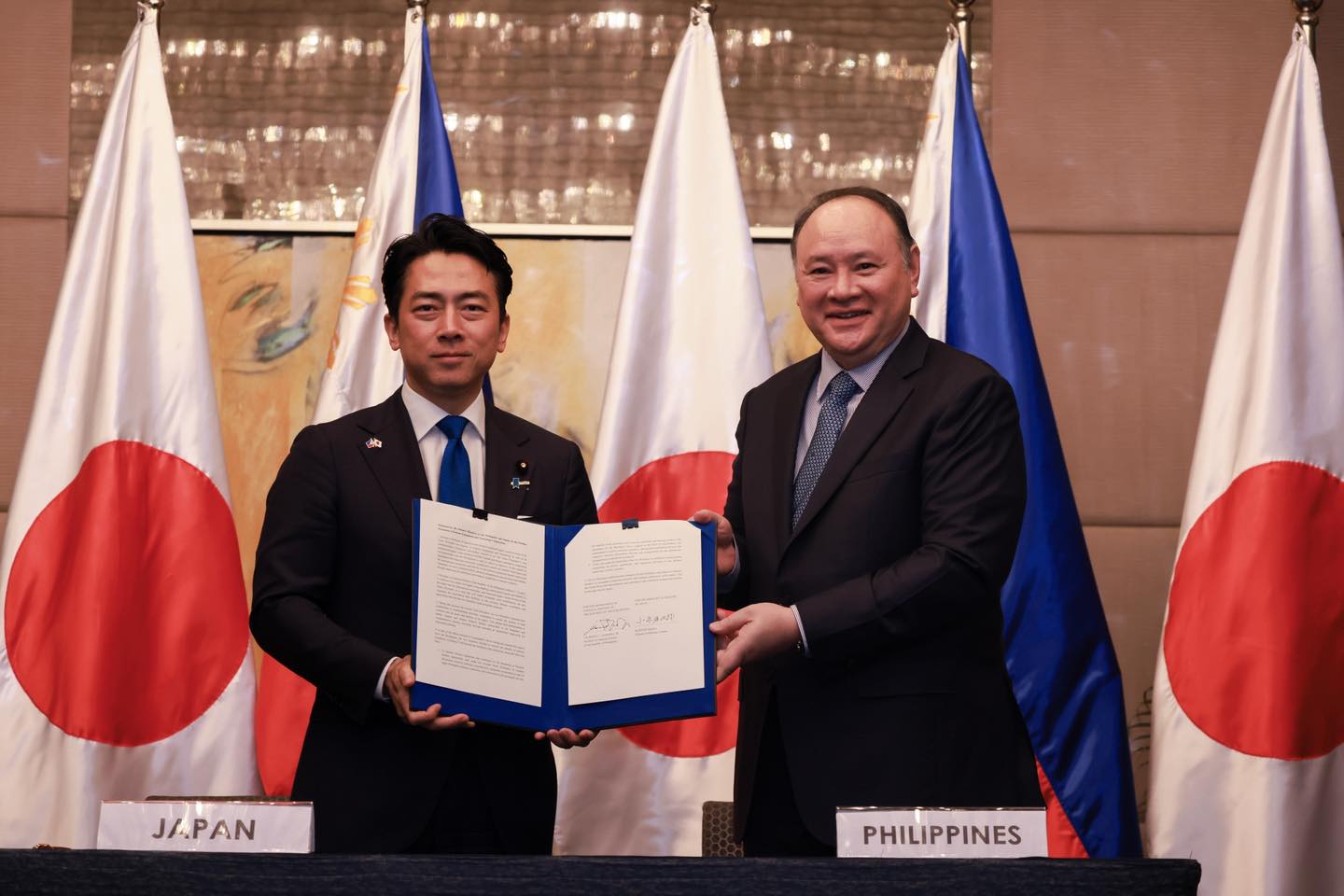
The Philippines and Japan took another step to deepen their ties following the signing of their statement on the further promotion of defense equipment and technology cooperation.
This was as Defense Secretary Gilberto Teodoro Jr. welcomed Japan Defense Minister Shinjiro Koizumi on Tuesday for a defense minister’s meeting, where Japan announced that the process is moving forward for the early transfer of Abukuma-class destroyers and TC-90 aircraft to the Philippines.
They also signed the statement outlining their shared commitment to strengthening cooperation after Japan revised its Three Principles on Transfer of Defense Equipment and Technology.
Teodoro said that the transfer of the Abukuma-class destroyers being discussed would be a grant or assistance from Japan to the Philippines. However, he added, "Yung transfer ay bigay. Pero ngayon pwede rin tayo bumili ng defense equipment kasi hindi na sila constrained na mag-transfer. Pero may guidelines yan. Kailangan aligned ang bansa sa kanila at nangingilala ng parehong mga prinsipyo sa ilalim ng international law."
(The transfer is a gift. But now we may also buy defense equipment because they are no longer constrained from transferring. But there are guidelines. The buyer country must be aligned with them and must also recognize the principles of international law.)
Koizumi said he had a “very productive and substantive discussion on defense cooperation” with Teodoro.
“At today’s meeting, we discussed where to further expand and deepen our cooperation in the areas of policy, operations, and defense equipment and technology, in a more integrated and comprehensive manner,” the Japanese official said in a press briefing.
“Secretary Teodoro and I signed today a statement on the further promotion of defense equipment and technology cooperation. Through this statement, we agree to establish a working group bringing together the policy, operational, and the equipment divisions of the defense authorities of both countries,” he added.
The Three Principles on Transfer of Defense Equipment and Technology provide a clear, updated roadmap for the international transfer of defense assets.
Balikatan
Koizumi is also in the country to witness the ongoing Balikatan exercises involving Philippine and US and troops.
He noted that Japan was also able to participate and bring equipment to the multilateral exercise.
“By applying the Reciprocal Access Agreement, which entered into force in September last year, through the ongoing US-Philippines hosted multilateral exercise Balikatan ‘26, we were able to bring in equipment to the Philippines and participate in more advanced training which had not been possible previously. As a result, the quality and the quantity of the exercise has improved dramatically,” Koizumi said.
Meanwhile, Koizumi said his country was eyeing the early transfer of Abukuma class destroyers and TC-90 aircraft to the Philippines after Tokyo unveiled its biggest overhaul of defense export rules in decades.
He said Japan had agreed with the Philippines to further promote defense technology under a new framework for the transfer of defense equipment.
Teodoro said both sides agreed in principle on the transfer of defense equipment and were working on details.
Both defense ministers did not provide a timetable for the equipment transfer, but agreed to establish a working group to craft policy and operational requirements for the eventual transfer.
Koizumi said both sides also agreed to move forward with discussions aimed at realizing comprehensive equipment cooperation, including education and training, maintenance and sustainment, and operational coordination.
“I stated that the revision by the government of Japan last month of the three principles on the transfer of defense equipment and Technology and its implementation guidelines will further strengthen Japan's contribution to peace and stability in the region and the world,” he said.
Japan and the Philippines are key allies of the United States and Japan and have been locked in maritime disputes with China, in the East and South China Seas respectively.
Teodoro condemned China’s recent remarks against Japan, particularly its reference to the past in warning the Philippines amid the deepening defense cooperation between Manila and Tokyo.
Teodoro said China was using such statements as a “smokescreen” for its own actions in the region.
“I condemn the vilification of Japan, belated vilification and inappropriate reference to the past by China's over-reliance to warn us and to smokescreen what they themselves... I condemn their vilification of Japan. It's unfair, uncalled for, and actually dishonest,” he said.
Shared objectives
Teodoro also expressed his gratitude to Japan for the renewed ties in the area of defense and security.
“We thank Japan once again for its review of the Three Principles on the Transfer of Defense Equipment and Technology, and its implementing guidelines. We are very happy to work with Japan in creating demonstrable results at the soonest possible time,” he said.
The chief of the Department of National Defense (DND) also commended his Japanese counterpart’s candid and frank approach with President Ferdinand "Bongbong" Marcos Jr. in discussing bilateral cooperation.
“Must I point out that a distinction in this visit of Minister Koizumi, that the minister was able to engage the President in very frank, candid, and clear objectives on our way forward, and so carried on the tenor of our discussions in our bilateral earlier,” Teodoro said.
“It serves as an example to all those down the line that they should be as open and candid with each other in order to achieve our shared objectives,” he added.
Teodoro also thanked the Japanese government for its assistance in addressing the Navotas Sanitary Landfill.
“We also thank Japan for being there when we most needed them, in natural calamities, humanitarian assistance, and disaster response, most recently in extending technical assistance to us in the Navotas Landfill fire,” he said. — JMA, GMA News

