

 GMA Brandtalk
 Tracking
 Archives

How did the SC rule that 'forthwith' in impeachment means 'a reasonable time'?
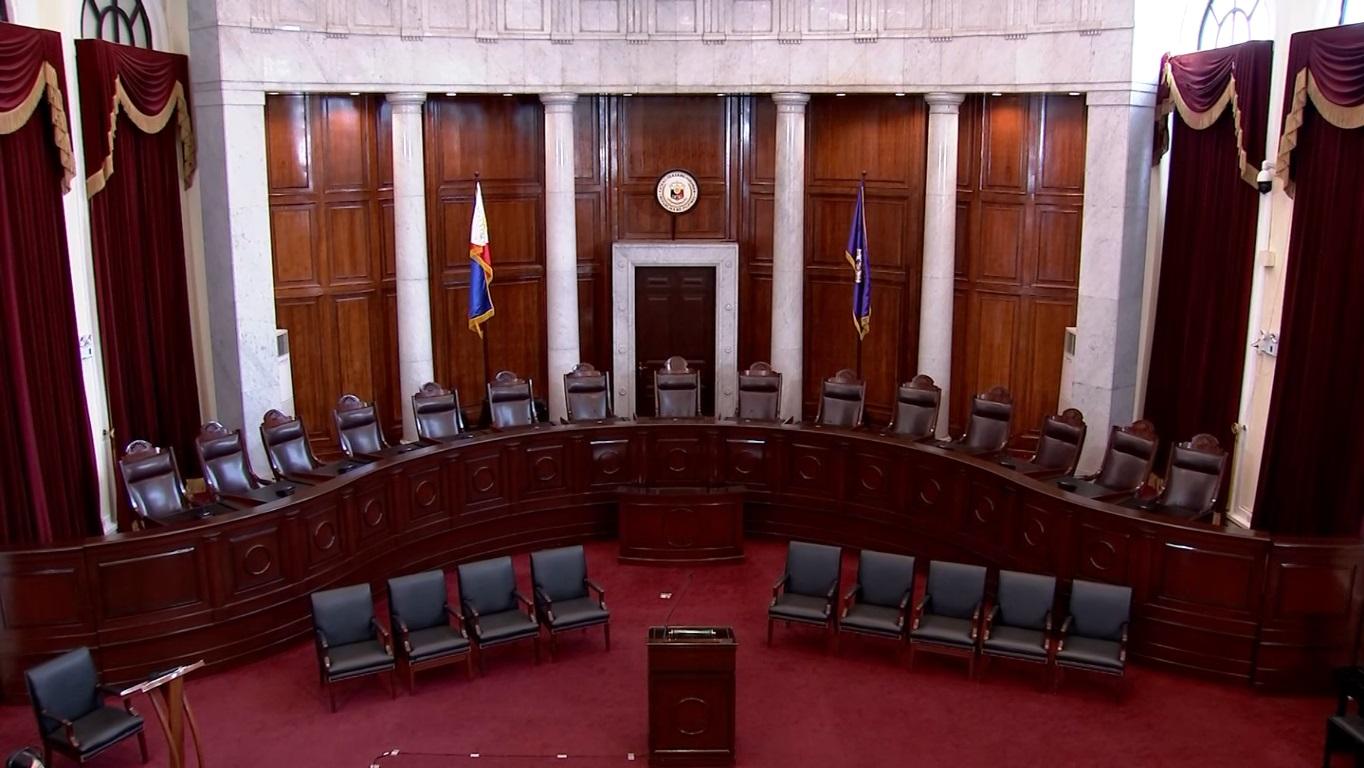
The Supreme Court (SC) on Tuesday made public its ruling that found the Senate did not commit grave abuse of discretion when it did not immediately convene as an impeachment court for the trial of Vice President Sara Duterte.
In its 28-page decision, the SC defined “forthwith” under Article XI, Section 3(4) of the Constitution as meaning “within a reasonable time” and not necessarily immediately, as the petitioner argued.
The SC En Banc voted 14-0-1 to dismiss the petition filed last year which sought to compel the Senate to “immediately” convene as an impeachment court and begin the trial of the Vice President.
How did the High Court reach its conclusion?
The High Court cited various definitions of “forthwith” under Black’s Law Dictionary, Philippine jurisprudence, and United States jurisprudence.
It also compared the preparations made for the impeachment trial of the Vice President with those undertaken in the impeachment trials of former President Joseph Estrada and former Chief Justice Renato Corona.
The SC said the Senate’s obligation under Section 3(4) includes not only conducting the trial but also preparatory acts for it.
“The petition fails to show — much less establish — how the Senate acted whimsically, capriciously, arbitrarily, out of malice, ill will, or personal bias in deciding not to instantly convene as an impeachment court as soon as the House filed the Articles of Impeachment,” it said.
“Thus, the Senate did not commit grave abuse of discretion since it had begun complying with its constitutional duty by preparing itself to conduct the impeachment trial, and the Constitution itself does not provide any specific period when the Senate must start the actual trial,” it added.
According to the Court, the petitioner’s insistence that the Senate immediately constitute itself as an impeachment court disregards preparatory steps already undertaken by the upper chamber.
SC cites Senate preparations
The Court noted the following activities:
- February 6, 2025 – Senate reexamined amendments to the Rules of Procedure on impeachment trials
- February 10, 2025 – Deputy Secretary for Administrative and Financial Services requested a review of budgetary requirements for the impeachment trial
- February 18, 2025 – readiness demonstration of a QR-based online visitor registration system
- February 18, 2025 – submission of documentation on ingress and traffic flow, furniture layouts, and seat capacities
- February 11 to 20, 2025 – preparation of design studies for personnel IDs, access tickets, and the impeachment court seal
- February 20, 2025 – then Senate President Francis “Chiz” Escudero issued Special Order No. 2025-015 organizing administrative support for the Senate sitting as an impeachment court
Meanwhile, the SC noted that in the impeachment trial of former President Joseph Estrada, the Senate convened as an impeachment court a week after the Articles of Impeachment were referred.
In the case of former Chief Justice Renato Corona, then Senate President Juan Ponce Enrile constituted and convened the Senate impeachment court the day after the chamber received the verified complaint.
The Court also noted that Congress was in session when the House transmitted and the Senate received the Articles of Impeachment in those earlier cases.
In Duterte’s case, however, the House transmitted the Articles after office hours on the last session day.
The SC added that Section 3(4) does not specify a fixed period for the Senate to begin trial.
“There is no textual commitment to a specific number of days for the Senate to begin the actual trial,” it said.
“This omission indicates that it is for the Senate to determine when it will conduct the actual trial, considering the preparations it deems necessary to convene as an impeachment court and discharge its duty as such,” it added.
Despite this, the Court stressed that “forthwith” remains a guiding constitutional standard.
“While the Constitution does not precisely fix the date when the trial must proceed, the Senate must not unduly delay the conduct of the trial, lest we render meaningless the Constitution’s mandate that public officers must, at all times, be accountable to the people,” it said.
Definitions of 'forthwith'
The SC cited Black’s Law Dictionary, which defines “forthwith” as immediately, without delay, promptly, or within a reasonable time under the circumstances.
In Philippine jurisprudence, the Court cited Fischer v. Ambler, where “forthwith” was interpreted to mean “within a reasonable time, which may be a longer or shorter period depending on the circumstances of each case.”
“A perusal of Philippine cases interpreting the term ‘forthwith’ reveals that in our jurisprudence, it means within a reasonable time, which may vary depending on the circumstances,” the SC said.
“That is, the term is elastic in nature and its meaning varies in every case,” it added.
In US jurisprudence, the Court noted that “forthwith” has been interpreted as without unnecessary delay, with due diligence, and as soon as practicable, depending on the facts of each case.
A comparative review of historical Senate records highlights stark differences in the handling of high-profile impeachment cases involving then President Joseph Estrada, Chief Justice Renato Corona and Vice President Sara Duterte.
The SC decision showed that the transmission and receipt of Articles of Impeachment by the Senate have historically been immediate or nearly immediate.
In the cases of Estrada (November 13, 2000) and Duterte (February 5, 2025), the Senate received the Articles on the same day they were transmitted by the House of Representatives.
A minimal one-day delay was recorded in the Corona impeachment in December 2011.
However, a wider divergence is evident in the time taken for the Senate to formally constitute itself as an impeachment court:
- President Joseph Estrada: convened in 7 days (November 20, 2000)
- Chief Justice Renato Corona: convened in 1 day (December 14, 2011)
- Vice President Sara Duterte: convened in 126 days (June 10, 2025)
Historical cases also differ significantly in how proceedings advanced after convening. In the Estrada and Corona cases, the Senate proceeded to formal trial within 17 days and 33 days, respectively.
In contrast, the impeachment proceedings against Duterte did not proceed to a full trial. After 58 days following the constitution of the impeachment court, the Senate voted to archive the Articles of Impeachment on August 6, 2025, effectively terminating the process.
Dissenting view
Meanwhile, Senior Associate Justice Marvic Leonen said the immediacy implied in “forthwith” required the Senate to convene the impeachment court and begin constitutional proceedings without delay.
“The Senate President’s immediate duty, upon receipt of the Articles of Impeachment, was to place the matter before the Senate for the purpose of constituting the impeachment court,” he said.
“It was the impeachment court, not the Senate as a legislative body, that should have supervised the preparations for the trial and determined the schedule of the proceedings,” he added.
Leonen stressed that interpreting “forthwith” in a manner that allows a four-month delay effectively weakens the accountability mechanism intended by the Constitution.
He also urged the Court to revisit its interpretation of Article XI, Section 3(4), although he acknowledged the case had become moot.
The decision was penned by Associate Justice Rodil Zalameda.—MCG, GMA News

