

 GMA Brandtalk
 Tracking
 Archives

WATCH: Taal Volcano minor phreatic eruption seen
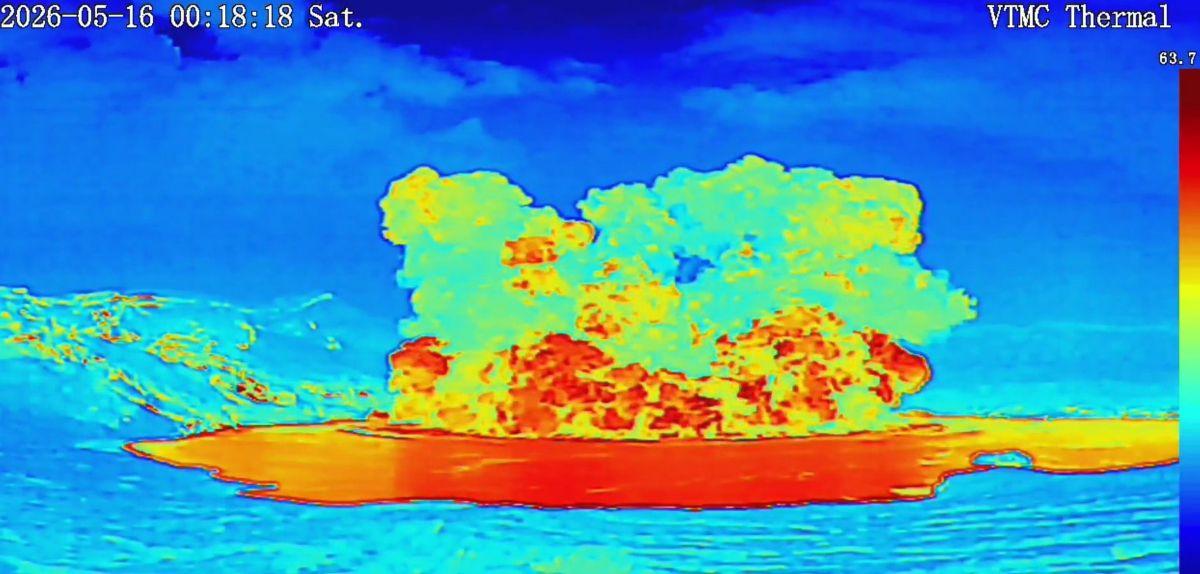
Taal Volcano in Batangas had a minor phreatic eruption early Saturday, the Philippine Institute of Volcanology and Seismology (PHIVOLCS) said.
The eruption occurred past 12 a.m. at the main crater and was caught on thermal cameras.
This resulted in plumes that rose up to 300 meters above the crater.
"Alert Level 1 prevails over Taal Volcano," PHIVOLCS said.
LOOK: Sped-up thermal camera footage of minor phreatic eruption at the Main Crater of Taal Volcano that occurred at AM today, 16 May 2026. This event generated plumes that rose 300 meters above the crater as recorded by the Main Crater (VTMC) and Daang Kastila (VTDK) thermal… pic.twitter.com/F484rTlYFq
— PHIVOLCS-DOST (@phivolcs_dost) May 15, 2026
According to the United States Geological Survey (USGS) a phreatic eruption is a "steam-driven explosion" that happens when magma heats the ground or surface water.
The intense heat can cause water to boil and flash into steam, which results in an explosion of water, steam, rock and ash.
"The water, once heated, begins to boil or can even flash straight to steam, causing an explosion," USGS said.
During phreatic eruptions, however, no new magma is produced, only fragments of preexisting solid rock from the volcano.
Meanwhile, from 12 a.m. Friday to 12 a.m. Saturday, Taal Volcano had five volcanic earthquakes, PHIVOLCS said in its bulletin.
A total of 1,641 tonnes of sulfur dioxide were also emitted during the same period.
Moderate plumes were also observed rising up to 1,500 meters tall before drifting in the west, northeast and northwest directions.
PHIVOLCS reiterated that entry into Taal Volcano Island which is a Permanent Danger Zone or PDZ, especially the Main Crater and Daang Kastila fissures, should not be allowed.
Likewise, occupancy and boating on Taal Lake and flying aircraft close to the volcano should be prohibited, it said.
Taal Volcano, at Alert Level 1 (Low-level unrest) poses possible hazards as follows, PHIVOLCS said:
- steam-driven or phreatic or gas-driven explosions;
- volcanic earthquakes;
- minor ashfall; and
- lethal accumulations or expulsions of volcanic gas.
—KG, GMA News

