

 GMA Brandtalk
 Tracking
 Archives

PHIVOLCS: More volcanic quakes, higher sulfur dioxide emissions recorded at Mayon
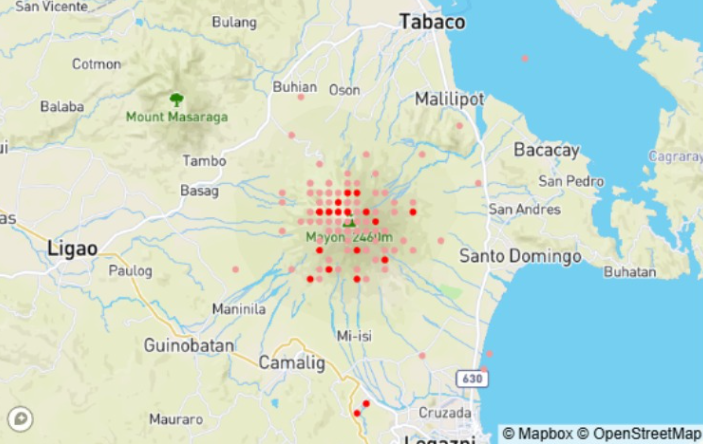
Increased volcanic earthquakes and higher sulfur dioxide emissions were recorded over Mayon Volcano in Albay during the past 24-hour monitoring period, the Philippine Institute of Volcanology and Seismology (PHIVOLCS) said Monday.
Based on its latest bulletin, PHIVOLCS recorded 45 volcanic earthquakes, including four volcanic tremor episodes lasting five to 12 minutes, higher than the 27 recorded in the previous monitoring period.
Sulfur dioxide flux was measured at 1,216 tonnes on Sunday, up from 988 tonnes recorded on Saturday.
However, Mayon logged fewer rockfall events and no pyroclastic density current (PDC) signals or "uson" activity.
Rockfall events declined to 290 from 341 in the previous report. No uson activity was detected during the 24-hour observation period, compared with two incidents recorded earlier.
Lava effusion continued from the summit crater, feeding lava flows extending along the Basud (3.8 kilometers), Bonga (3.2 km), and Mi-isi (1.8 km) gullies.
Minor strombolian activity was also observed, while crater glow was described as fair and visible to the naked eye.
Moderate volcanic plumes drifting southwest, west-northwest, and west-southwest were also observed.
PHIVOLCS said short-term deflation of the edifice, accompanied by shorter-term inflation on the northeastern flank, was observed.
Mayon remains under Alert Level 3, indicating intensified unrest or magmatic unrest.
Authorities continue to prohibit entry into the six-kilometer permanent danger zone (PDZ) and advised against unnecessary activity within the extended danger zone (EDZ).
Aircraft are also prohibited from flying close to the volcano due to possible ash emission and ballistic hazards.
PHIVOLCS warned that Mayon could generate rockfalls, landslides or avalanches, ballistic fragments, lava flows and lava fountaining, pyroclastic density currents, moderate explosions, and lahars during heavy and prolonged rainfall.—MCG, GMA News

