

 GMA Brandtalk
 Tracking
 Archives

Mayon Volcano sheds pyroclastic density current or 'uson' anew
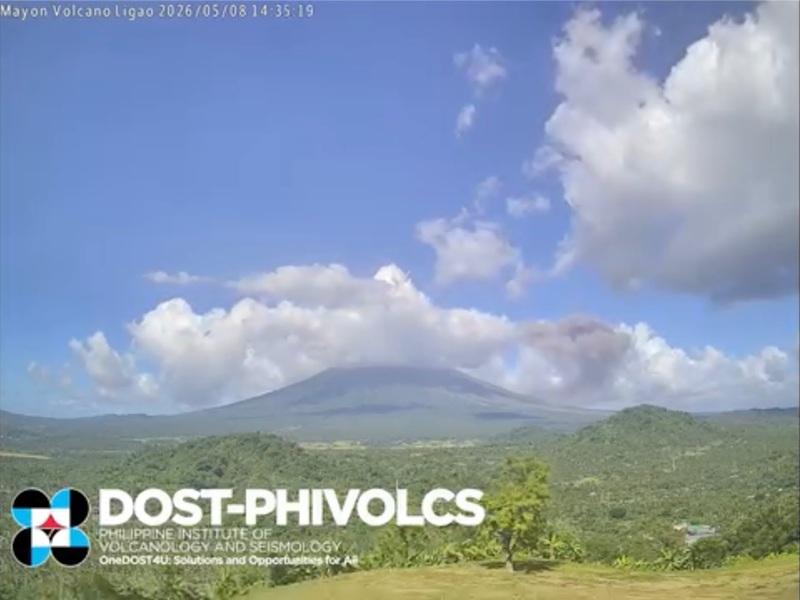
Pyroclastic density current known locally as "uson" were observed at Mayon Volcano in Albay on Monday morning, July 13, 2026, the Philippine Institute of Volcanology and Seismology (PHIVOLCS) said.
"ATM: Ongoing pyroclastic density current (PDC) or "uson" at the Mayon Volcano," PHIVOLCS said in a social media post at 7:28 a.m.
PDCs, which are life-threatening, are generated when an eruption column collapses under its own weight. Unlike typical rockfalls, which involve only rocks, PDCs are more dangerous due to their combination of gases, ash, and rocks, PHIVOLCS earlier explained.
READ: EXPLAINER: What are pyroclastic density currents or PDCs?
In its bulletin issued Monday morning, PHIVOLCS said Alert Level 3 remains in effect at Mayon Volcano since it remains in a state of intensified unrest or magmatic unrest.
In the past 24 hours, lava effusion was also observed at the volcano, with lava flows seen on the Basud Gully (3.8 km), Bonga Gully (3.2 km), and Mi-isi Gully (2.1 km).
Minor episodic Strombolian activity and short-lived lava fountaining also occurred on Sunday, PHIVOLCS said.
A total of 92 volcanic earthquakes and 299 rockfall signals meanwhile were recorded Sunday.
The volcano continues to be seen with a crater glow.
On Sunday, 5,842 tonnes of sulfur dioxide were emitted by Mayon Volcano.
Moderate plumes were seen rising out of the crater before drifting in the northeast direction on Sunday.
PHIVOLCS reiterated that the 6-km Permanent Danger Zone should be kept off limits.
Likewise, flying aircraft close to the volcano should not be allowed.
Mayon Volcano poses possible hazards such as the following, PHIVOLCS warned:
- rockfalls or landslides or avalanches
- ballistic fragments
- lava flows and lava fountaining
- pyroclastic density currents
- moderate-sized explosions
- lahars during heavy and prolonged rainfall
The volcano has been shedding PDCs this year, with the largest one monitored in February. —KG, GMA News

