

 GMA Brandtalk
 Tracking
 Archives

SONA 2026: How is the Marcos admin faring in terms of poverty alleviation?
A year has passed since President Ferdinand “Bongbong” Marcos Jr., in his 2025 State of the Nation Address (SONA), committed to continue fighting poverty and hunger in the country by creating more decent jobs and supporting small businesses. How is the government faring now in fulfilling this promise?
In his fourth SONA, the President said that the Department of Labor and Employment (DOLE), Department of Trade and Industry (DTI), Department of Social Welfare and Development (DSWD), and Department of Tourism (DOT), along with other agencies, would intensify efforts to generate opportunities for the 4% of the workforce who then remained unemployed.
He also vowed to offer low-interest-bearing and non-collateralized capital so that those in need could start small businesses or microenterprises.
“Para sa mga tinataguyod natin mula sa kahirapan, patuloy tayong nagbibigay ng libreng training at puhunan para makapagtayo sila ng sariling negosyo,” Marcos said last year.
(For those we are lifting out of poverty, we will continue to provide you with free training and capital so you can start your own businesses.)
“Hindi tayo titigil hanggang halos dalawa’t kalahating milyong maralitang pamilya ay matutulungan natin na magkaroon ng kanilang sariling maliit na negosyo,” he added.
(We will not stop until we have helped almost 2.5 million poor families start their own small businesses.)
The President also committed to strengthening various industries, like automotive, manufacturing, electronics, biotechnology, pharmaceuticals, critical minerals, local textiles, halal products, construction, and power generation.
He also made a resounding call to the international business community to invest in Filipinos.
“The Philippines is ready. Invest in the Filipino. Our cavalcade of dependable and hardworking Filipinos, innately skilled, adaptable, and possessed with a heart for service, are here, ready to work and to succeed with you,” Marcos stressed.
But a year later, millions of Filipinos remain unemployed and consider themselves poor.
Based on a Social Weather Station (SWS) survey conducted in late March 2026, 52% or 14.5 million Filipino families identify themselves as "poor.”
This was one percent higher than the 51% recorded in November 2025.
Of the estimated 14.5 million self-rated poor families in March 2026, 1.9 million were newly poor, 2.7 million were usually poor, and 9.9 million were always poor.
Meanwhile, a survey by the Philippine Statistics Authority (PSA) showed that 2.5 million Filipinos, ages 15 and above, were without jobs or livelihoods in May 2026.
This was higher than the 2.41 million jobless individuals in April, and the 2.03 million in May 2025. This translated to an unemployment rate of 4.8% in May 2026, also higher than 4.7% in April 2026 and 3.9% in May 2025.
Interventions
Now, what is the Marcos administration doing to address the country’s perennial problems in poverty and unemployment?
Malacañang said the government remains committed to creating quality and productive jobs for Filipinos, attracting investments, and providing livelihood opportunities to displaced workers and returning overseas Filipino workers.
DOLE, for its part, said that it is also strengthening labor education for graduating students and expanding its nationwide job fairs to help unemployed and underemployed individuals.
The agency said it is also enhancing partnerships with the Technical Education and Skills Development Authority (TESDA) to improve skills development, and is integrating entrepreneurship interventions into the Tulong Panghanapbuhay sa Ating Disadvantaged/Displaced Workers (TUPAD) program for disadvantaged and displaced workers.
Notably, the government also continues to implement its national poverty reduction strategy and human capital investment program through the Pantawid Pamilyang Pilipino Program (4Ps).
In May, the DSWD said around 1.4 million families have already “graduated” from the 4Ps since 2022, prompting the government to restore only 500,000 beneficiaries as part of a recalibrated anti-poverty effort under the Marcos administration.
The DSWD also began rolling out recently an expanded First 1,000 Days cash grant package, increasing the monthly benefit for qualified 4Ps beneficiaries from P350 to P750.
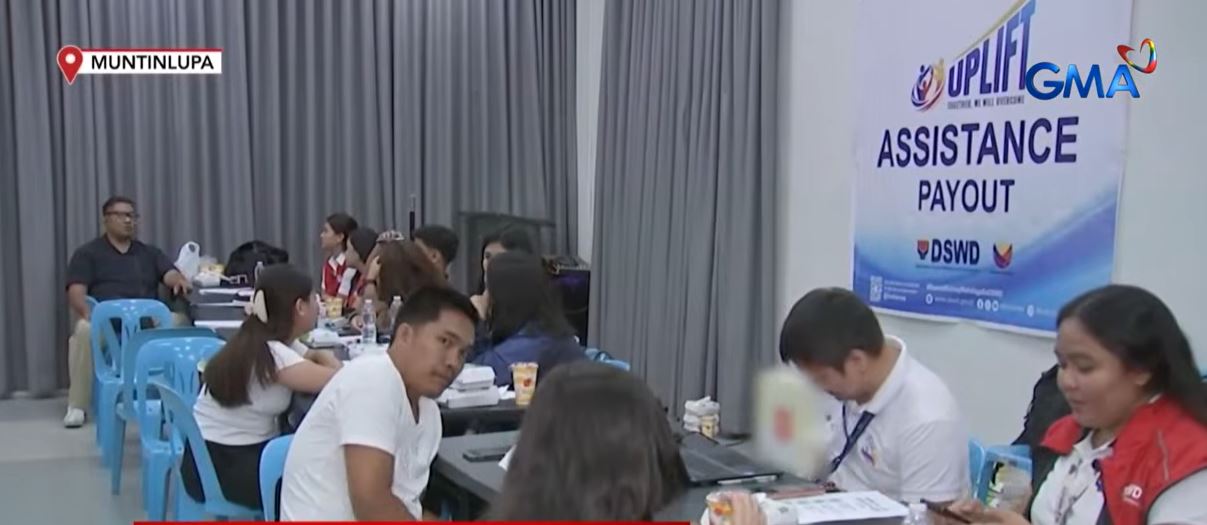
Due to the impacts of the Middle East conflict, the government also decided to expand the United Package for Livelihoods, Industry, Food, and Transport (UPLIFT) program, providing financial assistance to indigent Filipinos affected by rising prices of fuel and other commodities.
The DSWD said that this program will also cover tax-paying near-poor earners and not just the poorest, targeting to benefit a total of 7.5 million households or 37.5 million individuals.
Likewise, the DSWD is also continuously implementing the Walang Gutom program, which seeks to address involuntary hunger among low-income households.
Under the Bawat Bayan Makikinabang program, the government also distributes 10-kilogram sacks of rice to select beneficiaries, which include farmers, fisherfolk, senior citizens, solo parents, and low-income earners.
Water, power services
Marcos’ commitment to improving the lives of Filipinos also does not stop with these interventions, as access to clean water and reliable energy remain crucial.
In his previous SONA, the President issued a stern warning to water service providers and their joint venture partners who were liable for the water service interruptions in several parts of the country.
Despite government projects aimed at providing clean and safe water supply, he said many consumers had complained that water was not reaching their taps.
“Sa lawak ng reklamo, lampas anim na milyong konsyumer sa buong bansa ang kasalukuyang naaapektuhan. Nakita ko na ang report,” the President said in his 4th SONA.
(Over six million consumers nationwide are affected because of this issue. I have already seen the report.)
“Titiyakin nating mapapanagot ang mga nagpabaya at nagkulang sa mahalagang serbisyong-publiko na ito,” he added.
(We will ensure that those who were negligent or fell short in delivering this essential public service will be held accountable.)
According to Marcos, the Local Water Utilities Administration (LWUA) would address the water supply issues concerning water districts and their joint venture partners.
Currently, Malacañang said the government continues to implement measures to improve water services nationwide, including developing new water sources, expanding water networks, and studying legal remedies against water districts and joint venture partners that fail to fulfill their obligations.
The LWUA and the Asian Development Bank (ADB) are also jointly implementing a P1.99-billion Water District Development Sector Project to strengthen water districts and improve water services across the Philippines.
Last year, the President also lamented that three million households did not have electricity, and many Filipinos still suffered from high power costs despite experiencing frequent brownouts.
He thus vowed to provide electricity to at least one million more homes by 2028 through the use of solar power home system.
But because of the conflict in the Middle East, which escalated in February, global supply chains were affected, and the country’s energy sector faced power disruptions and supply shortages that directly affected consumers.
In March, Marcos declared a state of national energy emergency, directing and authorizing the Department of Energy (DOE) to take appropriate measures to safeguard the stability and adequacy of the country's energy supply and mitigate the adverse effects of disruptions in global energy supply markets.
Come June, DOE reported that the Philippines had the most expensive electricity rates among the member countries of the Association of Southeast Asian Nations (ASEAN) due to low supply and high demand recorded during the month.
Malacañang said the President has given orders to build new power plants to increase energy production, expand the transmission network, and implement measures to address issues delaying the construction of submarine cables and transmission lines.
Marcos has also called for action on power-related concerns, including those of the National Grid Corporation of the Philippines (NGCP).—AOL, GMA News

